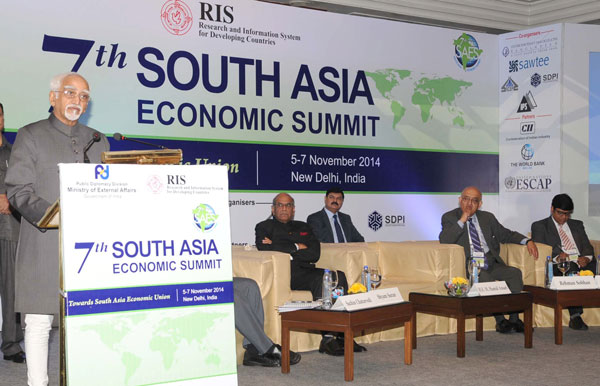
Hamid Ansari inaugurates 7th South Asia Economic Summit
Delivering inaugural address at the “7th South Asia Economic Summit organised by Research and Information System for Developing Countries” in New Delhi, he said that in this regard, Think-tanks have to stay ahead of governments and generate ideas and come up with possible ways forward.
Therefore, this summit of regional think-tanks focusing on this ambitious theme is a welcome initiative.
Ansari said, At the 17th SAARC Summit, held at Maldives in 2011, South Asian leaders spoke about the need to work on a vision for future development of South Asia, including the goal and elements of a South Asian Economic Union (SAEU).
He said that Intra-regional trade in South Asia has doubled since the region implemented the Agreement on South Asian Free Trade Area (SAFTA). The intra-regional exports have increased to about US$ 22 billion in 2013 from US$ 10 billion in 2006 (data source: IMF).
South Asia is expected to achieve substantial tariff reduction by 2016 as SAFTA implementation makes further progress. This should lead to a greater increase in intra-regional trade.
Vice President said that while SAEU would require greater regional economic policy coordination, SAARC would benefit from the experiences of other groupings, such as the European Union and ASEAN.
Some prioritised progression may be useful, beginning from completing the on-going trade liberalisation process. Another priority would be to undertake investment in regional infrastructure, especially transport connectivity that would facilitate ease of travel and trade.
He said that some of the regional trade facilitation projects may ease the way for an economic union.
These could be (i) coordinated border management, such as co-location of facilities, delegation of administrative authority, cross-designation of officials, and effective information sharing; (ii) regional single window which is a digital interface that allows traders to submit all information and documentation required by regulatory agencies via a single electronic gateway; and (iii) regional transit, which would help the region to move the goods and services move freely, thereby strengthening production networks in South Asia.
Vice President said that creation of South Asian Economic Union (SAEU) would prove to be a milestone in regional cooperation efforts.
Most regions in the world are moving towards greater economic integration, as South Asia lags behind.
The logic of economic union lies in re-distribution of common and shared resources within the region in a most efficient and effective manner.
Economic union enhances manifold the bargaining power of member countries in the global arena and helps in realising the full potential of trade complementarities.
There are definite advantages of moving towards an economic union but the roadmap has to be well thought out and a strategy has to be in place, which is ambitious but realistic.
Support Our Journalism
We cannot do without you.. your contribution supports unbiased journalism
IBNS is not driven by any ism- not wokeism, not racism, not skewed secularism, not hyper right-wing or left liberal ideals, nor by any hardline religious beliefs or hyper nationalism. We want to serve you good old objective news, as they are. We do not judge or preach. We let people decide for themselves. We only try to present factual and well-sourced news.
Support objective journalism for a small contribution.