'India working on 2 nm chip, working on most advanced tech in the world': Ashwini Vaishnaw
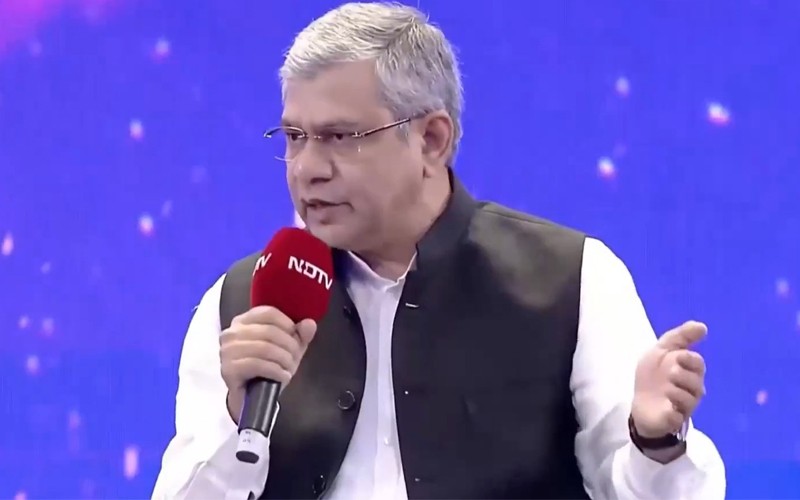
New Delhi: India is making rapid strides in digital innovation, encompassing digital credit, fast mobile data, and large language models (LLMs), Union IT Minister Ashwini Vaishnaw stated on Saturday.
Displaying a palm-sized homegrown semiconductor wafer at the NDTV World Summit, Vaishnaw said the innovation has the potential to challenge global chip industry leaders.
Emphasising the importance of data sovereignty, he said data must remain geographically within India.
"Data is the new oil," Vaishnaw said. "Data centers are the new refineries. The new economy which is taking shape in today's economy. We must take control of our destiny and make sure that the talent we have in our country finds opportunities here."
Looking forward to using Bharat’s Sarvam AI model! 🇮🇳
— Ashwini Vaishnaw (@AshwiniVaishnaw) October 18, 2025
Swadeshi model focused on engineering innovation, unbiased and multilingual.
📍NDTV World Summit 2025, New Delhi pic.twitter.com/W5y9XsvtJa
He noted that India is now using cutting-edge technology to produce some of the world’s most advanced chips.
"We have a very significant talent base that has given us a unique strength. Already, 20 percent of our design engineers, global design engineering talent, is in India. And today we are designing chips of 2 nanometers in our country," he said.
"Earlier, it used to be 5 nanometers, 7 nanometers. Now 2-nanometer chips are here; they are the most complex of chips, the smallest. Those are now designed in India," he added, holding up the wafer as an example of India’s progress.
Explaining the precision involved in chip fabrication, Vaishnaw said, "This is a very complex industry because the magnitude and dimensions at which we have to work and the complexity are really, really difficult. So, a chip can be extremely small, you can't even see it with a microscope. It's 10,000 times smaller than human hair."
He likened the chip-making process to building an entire city on a wafer.
"This is a wafer. On this, building a complete city which will have its own plumbing, its own heating, its own electrical network, its own circuits and huge, it's a very, very complex thing," he said.
Sharing an anecdote, the minister said someone once told him that a five-minute power cut in a chip plant caused “a loss of $200 million.”
He added that chip fabrication requires “extremely pure, ultra-pure chemicals and gases, 500-plus chemical parts per billion purity.”
Support Our Journalism
We cannot do without you.. your contribution supports unbiased journalism
IBNS is not driven by any ism- not wokeism, not racism, not skewed secularism, not hyper right-wing or left liberal ideals, nor by any hardline religious beliefs or hyper nationalism. We want to serve you good old objective news, as they are. We do not judge or preach. We let people decide for themselves. We only try to present factual and well-sourced news.
Support objective journalism for a small contribution.