 SIR
SIR
Jolt to Opposition! Supreme Court upholds SIR, says ECI can examine citizenship within limits
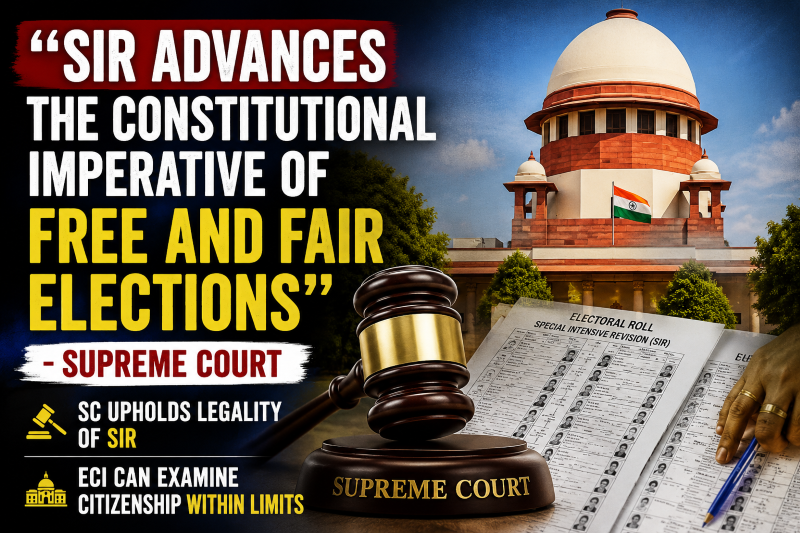
New Delhi/IBNS: The Opposition’s criticism of the Election Commission of India’s (ECI) voter revision exercise suffered a setback after the Supreme Court on Wednesday upheld the legality of the Special Intensive Revision (SIR) of electoral rolls in Bihar and other states, media reports said.
Supreme Court Backs ECI’s Powers
A bench comprising Chief Justice of India Surya Kant and Justice Joymalya Bagchi ruled that the ECI is well within its constitutional and statutory powers to conduct the SIR exercise, which is currently underway across the country.
The bench also praised the voter revision drive, observing that it strengthens the constitutional objective of ensuring free and fair elections.
According to Live Law, the court said: “SIR advances the constitutional imperative of free and fair elections.... Free and fair elections do not rest merely upon the mechanics of polling.”
The bench further observed: “They fundamentally depend upon the integrity, accuracy and credibility of the electoral rolls, which form the foundation of the democratic process.”
Can ECI Determine Citizenship?
Addressing the question of whether the ECI can determine the citizenship status of an individual, the Supreme Court clarified that the poll body can examine citizenship only within a limited electoral context.
The court said the ECI may examine citizenship-related issues during the SIR process for the purpose of deciding inclusion or exclusion from electoral rolls, but such scrutiny does not amount to a final determination of citizenship under Indian law.
The judgment, as quoted by Live Law, stated: “Upon detailed consideration, we have come to the conclusion that, in view of the statutory requirement under Section 16 of the Representation of the People Act, the Commission, in the course of preparing or revising electoral rolls, is undoubtedly empowered to examine questions bearing upon citizenship.”
Scope Of ECI’s Authority Limited
The bench, however, underlined that the ECI’s inquiry remains confined to electoral purposes only.
“Such an inquiry can only be undertaken from the limited standpoint of determining inclusion or exclusion from the electoral rolls,” the court observed.
The judges added that any such finding would affect only a person’s eligibility to vote and would not decide their citizenship status permanently.
“It does not, however, operate to divest the individual of claims to citizenship, nor does it foreclose adjudication of that question by the competent authority under the Citizenship Act,” the bench said.
Where Has SIR Been Conducted?
The Special Intensive Revision (SIR) exercise, which was first controversially rolled out in Bihar last year, was later expanded to nine states, including several poll-bound regions, in its second phase.
The ECI has already announced that the third phase of the exercise will cover 16 states and union territories. However, Himachal Pradesh, Jammu and Kashmir and Ladakh have been excluded from the process for now.
How Did The Opposition React To SIR?
The voter revision drive triggered sharp political reactions, particularly from Opposition parties, which alleged that the exercise could be used to target certain sections of voters and demanded judicial intervention.
The strongest protest came from the Trinamool Congress, which was voted out of power in West Bengal by the ruling Bharatiya Janata Party earlier this month.
TMC supremo Mamata Banerjee, who was then the Chief Minister of the state, had personally approached the Supreme Court, escalating the party’s legal and political battle against the ECI over the voter revision process.
What Does This Judgement Mean For The Opposition?
Against this backdrop, the Supreme Court’s endorsement of the SIR process is being viewed as a major setback for the Opposition.
By upholding the legality of the exercise and describing accurate electoral rolls as fundamental to free and fair elections, the top court has effectively strengthened the ECI’s position amid the political controversy surrounding the voter revision drive.
Support Our Journalism
We cannot do without you.. your contribution supports unbiased journalism
IBNS is not driven by any ism- not wokeism, not racism, not skewed secularism, not hyper right-wing or left liberal ideals, nor by any hardline religious beliefs or hyper nationalism. We want to serve you good old objective news, as they are. We do not judge or preach. We let people decide for themselves. We only try to present factual and well-sourced news.
Support objective journalism for a small contribution.