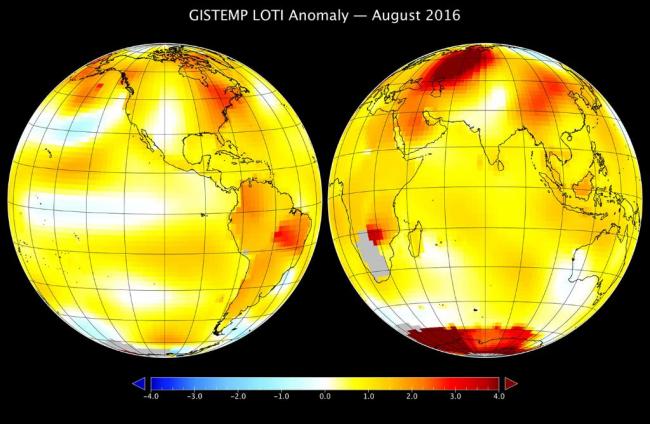
NASA says August 2016 warmest in 136 years of modern records
The monthly analysis of global temperatures by scientists at NASA’s Goddard Institute for Space Studies (GISS) revealed the finding.
GISS reported that although the seasonal temperature cycle typically peaks in July, August 2016 wound up tied with July 2016 for the warmest month ever recorded. August 2016's temperature was 0.16 degrees Celsius warmer than the previous warmest August in 2014.
Last month also was 0.98 degrees Celsius warmer than the mean August temperature from 1951-1980, GISS said.
The monthly analysis by the GISS team is assembled from publicly available data acquired by about 6,300 meteorological stations around the world, ship- and buoy-based instruments measuring sea surface temperature, and Antarctic research stations.
The modern global temperature record begins around 1880 because previous observations didn't cover enough of the planet.
Image: NASA Twitter
Support Our Journalism
We cannot do without you.. your contribution supports unbiased journalism
IBNS is not driven by any ism- not wokeism, not racism, not skewed secularism, not hyper right-wing or left liberal ideals, nor by any hardline religious beliefs or hyper nationalism. We want to serve you good old objective news, as they are. We do not judge or preach. We let people decide for themselves. We only try to present factual and well-sourced news.
Support objective journalism for a small contribution.