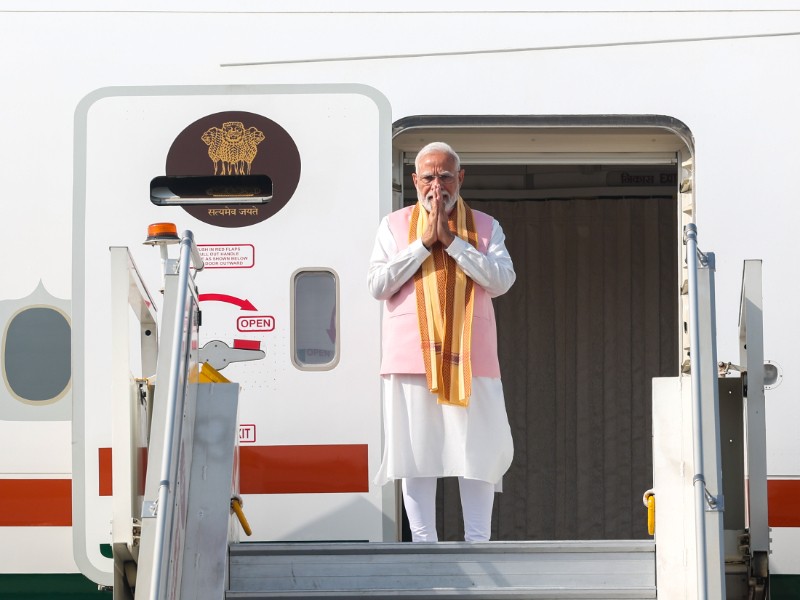
PM Modi leaves for Central Asia tour: What India wants from Uzbekistan and SCO summit
Prime Minister Narendra Modi’s four-day visit to Uzbekistan and the Kyrgyz Republic comes at a time when Central Asia is becoming increasingly important to India’s economic, security and connectivity calculations.
Modi began his visit to Uzbekistan on Saturday (August 29) and will travel to Bishkek for the 26th Shanghai Cooperation Organisation (SCO) Council of Heads of State Summit from August 31 to September 1.
The itinerary combines a bilateral state visit with one of the region’s most consequential multilateral gatherings.
The immediate agenda ranges from trade, investment and energy to defence, digital connectivity and education.
At the SCO summit, India is expected to emphasise security, counter-terrorism, connectivity and economic cooperation while Modi is also scheduled to hold bilateral engagements with other leaders, including Russian President Vladimir Putin.
The visit also comes shortly before India hosts the BRICS Summit in New Delhi on September 12-13, giving the Central Asian engagement an additional diplomatic dimension.
Uzbekistan: Turning strategic ties into economic opportunities
Modi’s first stop is Tashkent, where he is holding delegation-level talks with Uzbek President Shavkat Mirziyoyev.
This is Modi’s fourth visit to Uzbekistan as prime minister.
According to the Uzbek presidency, discussions are expected to cover trade, energy, chemicals, geology, healthcare, pharmaceuticals, agriculture and mechanical engineering, alongside political dialogue and cultural and humanitarian exchanges.
A substantial package of bilateral agreements is also planned.
India and Uzbekistan have already built a strategic partnership, but the economic relationship remains an area with considerable room for expansion.
Bilateral trade reached $1.3 billion in 2025, an increase of 33.3 percent from the previous year, according to Indian government data.
Uzbekistan's imports from India reached $1.15 billion, while its exports to India stood at $164.6 million.
Indian services exports to Uzbekistan were valued at $372.2 million in 2024.
The trade basket also reflects the complementary nature of the two economies.
Indian businesses have a significant presence in pharmaceuticals and other manufactured goods, while Uzbekistan offers opportunities in areas including energy, minerals, agriculture and industrial production.
The two governments are therefore looking beyond simply increasing trade volumes towards building longer-term industrial and investment partnerships.
Over the next few days, will be in Uzbekistan and the Kyrgyz Republic.
— Narendra Modi (@narendramodi) August 29, 2026
The programmes include:
Bilateral talks with President Shavkat Mirziyoyev in Tashkent to improve the India-Uzbekistan friendship.
Visit to the Shastri Memorial and the Mahatma Gandhi Centre at the…
Critical minerals and energy move up the agenda
Uzbekistan’s mineral resources add another strategic layer to the relationship.
The country is an important producer of uranium and has significant deposits of copper, tungsten and other minerals that are increasingly relevant to global technology and clean-energy supply chains.
For India, access to reliable sources of critical minerals and nuclear fuel is becoming increasingly important as domestic manufacturing, electronics, clean energy and infrastructure expand.
Energy cooperation is consequently expected to remain an important part of the discussions in Tashkent, alongside efforts to deepen commercial engagement.
Healthcare and pharmaceuticals are another established area of Indian-Uzbek cooperation.
Indian pharmaceutical companies have developed a sizeable presence in the Uzbek market, while discussions on manufacturing and investment can potentially allow companies to use Uzbekistan as a base for accessing wider Central Asian markets.
Digital connectivity and education broaden the relationship
The India-Uzbekistan relationship is also moving beyond traditional sectors.
Digital public infrastructure and digital payments are emerging as areas where India can offer technological expertise.
Cooperation involving digital systems, e-governance and payment infrastructure forms part of the broader conversation around India's digital strengths.
Education provides another important people-to-people link. More than 16,000 Indian students are studying in Uzbekistan, particularly in medicine and engineering, according to recent reports.
Indian educational institutions have also established campuses and partnerships in the country.
Defence cooperation remains another pillar.
The annual DUSTLIK exercise between the Indian and Uzbek armed forces has focused on counter-terrorism and tactical operations, while military training and professional exchanges continue to expand.
Why Central Asian connectivity matters to India
Geography remains one of the central issues in India's Central Asia strategy.
India does not share a direct land border with the Central Asian republics.
Pakistan's geography blocks a straightforward overland route, leaving India dependent on multimodal corridors involving sea, rail and road connections.
This is where Chabahar Port in Iran assumes strategic importance.
India has invested in the Shahid-Behesti terminal at Chabahar to create an alternative route linking Indian ports with Iran and onward to Afghanistan and Central Asia.
The International North-South Transport Corridor is another major part of India's connectivity strategy, linking India with Iran, Central Asia and Russia through a combination of maritime, rail and road networks.
For India, making these routes commercially viable is closely connected to its objective of expanding trade with landlocked Central Asian economies.
SCO takes centre stage
From Tashkent, Modi will travel to Bishkek to attend the 26th SCO summit.
The grouping brings together India, China, Russia, Pakistan, Iran, Kazakhstan, Kyrgyzstan, Tajikistan, Uzbekistan and Belarus.
The organisation provides India with a platform where its interests intersect directly with those of Russia, China and Central Asian states.
The summit agenda is expected to cover regional security, counter-terrorism, economic cooperation, connectivity and development.
Recent reporting on the summit has highlighted India's emphasis on security, connectivity and economic opportunity.
For New Delhi, terrorism remains one of the central issues.
Modi has said India's regional vision is anchored in “Security, Connectivity and Opportunity” and stressed the need for a region free from terrorism, separatism and extremism.
The emphasis is significant because Central Asia sits at the intersection of several security concerns, including instability emanating from Afghanistan, transnational terrorism, drug trafficking and radicalisation.
Modi-Putin meeting
One of the most closely watched engagements in Bishkek will be Modi's scheduled meeting with Russian President Vladimir Putin.
The Ministry of External Affairs has confirmed that the two leaders will meet on the sidelines of the SCO summit.
MEA Secretary (West) Sibi George said the two sides would review the “entire gamut” of their bilateral relationship.
The meeting comes shortly after the India-Russia Inter-Governmental Commission discussions in Moscow and an interaction between External Affairs Minister S Jaishankar and Putin.
Trade, energy, defence cooperation and the wider bilateral economic relationship are expected to remain central to the discussions.
The engagement is also significant because Putin is scheduled to visit New Delhi for the BRICS Summit shortly afterwards, creating an opportunity for the two leaders to maintain momentum in high-level India-Russia engagement.
Will Modi meet Xi Jinping?
Chinese President Xi Jinping is also expected to attend the Bishkek SCO summit.
China has confirmed Xi's participation in the gathering, which forms part of his wider regional itinerary.
Whether Modi and Xi hold a bilateral meeting has attracted considerable attention.
While a meeting would provide an opportunity to discuss India-China relations, the formal schedule has to be distinguished from speculation surrounding possible bilateral contacts.
The two countries have been working to stabilise their relationship after prolonged tensions along the Line of Actual Control (LAC).
Any direct interaction between Modi and Xi in Bishkek would therefore carry significance beyond the SCO's multilateral agenda.
It could also provide an important diplomatic touchpoint ahead of the BRICS Summit in New Delhi.
Kyrgyzstan ties beyond SCO
Modi's engagement in Bishkek is not limited to the SCO.
He is expected to hold bilateral talks with Kyrgyz President Sadyr Zhaparov, with discussions likely to cover ongoing cooperation in healthcare, education, defence and economic relations.
India and Kyrgyzstan have developed close defence ties through the annual Khanjar exercise, which focuses on special forces operations, mountain warfare and counter-terrorism.
Healthcare is another important area. India has provided medical assistance and developed telemedicine links, while Kyrgyz citizens have increasingly used Indian healthcare facilities for specialised treatment.
Modi will also attend the opening ceremony of the sixth World Nomad Games as a guest of honour, adding a cultural dimension to the visit.
Central Asia fits into India's wider diplomatic strategy
The significance of the four-day tour extends beyond the immediate meetings in Tashkent and Bishkek.
Central Asia has become increasingly important to India's efforts to diversify trade routes, secure energy and mineral supplies, expand defence partnerships and maintain diplomatic engagement with a region where Russia and China have traditionally exercised considerable influence.
Uzbekistan provides India with a major economic and demographic partner in the heart of Central Asia, while Kyrgyzstan offers an important platform for defence, security and regional diplomacy.
The SCO, meanwhile, brings together the principal powers shaping Eurasian geopolitics.
With the BRICS Summit due to take place in New Delhi less than two weeks after the Bishkek SCO meeting, Modi's Central Asia tour places bilateral economic partnerships, regional security and major-power diplomacy within a tightly connected diplomatic calendar.
Support Our Journalism
We cannot do without you.. your contribution supports unbiased journalism
IBNS is not driven by any ism- not wokeism, not racism, not skewed secularism, not hyper right-wing or left liberal ideals, nor by any hardline religious beliefs or hyper nationalism. We want to serve you good old objective news, as they are. We do not judge or preach. We let people decide for themselves. We only try to present factual and well-sourced news.
Support objective journalism for a small contribution.