PM Modi, Priyanka Gandhi Vadra face off in Parliament over history and legacy of ‘Vande Mataram’
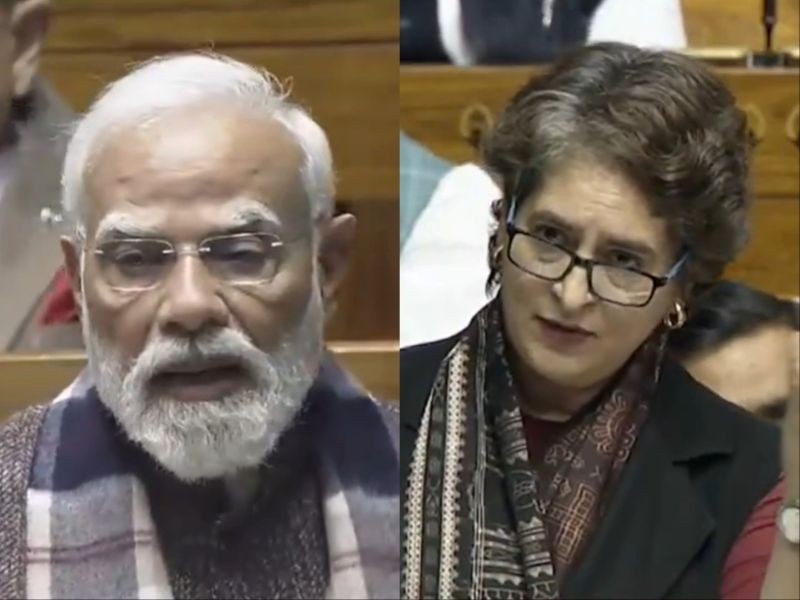
The 150th anniversary of the national song Vande Mataram triggered an intense political confrontation in Parliament on Tuesday, with Prime Minister Narendra Modi and Congress MP Priyanka Gandhi Vadra delivering sharply contrasting interpretations of its historical journey and contemporary relevance.
During a spirited defence of her party, Priyanka Gandhi accused the government of deliberately spotlighting the issue ahead of the upcoming Bengal assembly election, claiming the ruling party was attempting to divert attention from pressing national concerns.
She argued that Vande Mataram “lives in every corner of the country,” leaving no real reason to debate its place or acceptance.
“The government wants us to remain stuck in the past because it does not want to discuss the present or future,” she said, emphasising that Parliament’s time should be spent on issues directly affecting citizens.
She further accused the Prime Minister of selectively quoting Jawaharlal Nehru and suggested that the BJP should compile every alleged insult against Nehru, set aside dedicated time to debate it, and “close the chapter” instead of repeatedly invoking it in political arguments.
PM Modi’s counterpoint
Responding in the Lok Sabha, Prime Minister Modi accused the Congress of having “surrendered before the Muslim League” during the pre-Independence years, claiming the party had agreed to truncate Vande Mataram under political pressure.
He argued that Nehru had echoed Muhammad Ali Jinnah’s 1937 criticism that the song could “irritate Muslims,” leading to the removal of stanzas considered controversial.
Modi said this decision reflected what he called the Congress’s long-standing “appeasement politics,” which, according to him, contributed to deepening communal divides during that era.
तुष्टिकरण की राजनीति के दबाव में कांग्रेस वंदेमातरम् के बंटवारे के लिए झुकी, इसीलिए कांग्रेस को एक दिन भारत के बंटवारे के लिए झुकना पड़ा। pic.twitter.com/mrf1mw6C6x
— Narendra Modi (@narendramodi) December 8, 2025
Priyanka rejected the Prime Minister’s assertions, insisting that Nehru had described the objections to Vande Mataram as “manufactured by communalists.”
She read from Nehru’s correspondence with Subhas Chandra Bose and Rabindranath Tagore to argue that the final selection of the song’s stanzas followed thoughtful deliberation rather than political capitulation.
हमारे राष्ट्रगीत और राष्ट्रगान दोनों का चुनाव और निर्धारण करने में सबसे बड़ी भूमिका गुरुदेव रवींद्रनाथ टैगोर की थी। इसे संविधान सभा ने भी स्वीकार किया। इस पर सवाल उठाना न सिर्फ हमारे स्वतंत्रता आंदोलन के नायकों और महापुरुषों का अपमान है, बल्कि समूची संविधान सभा का अपमान है।… pic.twitter.com/VL26xCATuo
— Priyanka Gandhi Vadra (@priyankagandhi) December 8, 2025
Citing Tagore’s letters, Priyanka highlighted that the first two stanzas—those sung during the freedom struggle—were considered spiritually and culturally significant. In contrast, the later stanzas were viewed as potentially sensitive in the volatile climate of the 1930s.
The Congress Working Committee subsequently adopted Vande Mataram as the national song in October 1937.
DMK MP A Raja supported this interpretation, noting that while Nehru had acknowledged some concerns raised by certain communities, he had simultaneously criticised the communal framing of the controversy.
The anniversary marks 150 years since Bankim Chandra Chatterjee first published Vande Mataram in the magazine Bangadarshan on November 7, 1875.
The hymn, later incorporated into his novel Anandamath, evolved into a rallying cry during India’s freedom movement and remains an emblem of national pride.
What began as a commemoration of this milestone ultimately reignited a long-standing political and historical dispute—one that Parliament has debated many times but continues to provoke strong emotions across party lines.
Support Our Journalism
We cannot do without you.. your contribution supports unbiased journalism
IBNS is not driven by any ism- not wokeism, not racism, not skewed secularism, not hyper right-wing or left liberal ideals, nor by any hardline religious beliefs or hyper nationalism. We want to serve you good old objective news, as they are. We do not judge or preach. We let people decide for themselves. We only try to present factual and well-sourced news.
Support objective journalism for a small contribution.