 Khalistan
The Khalistan threat in Canada and its global implications
The specter of Khalistan extremism is not a specter that haunts the Sikh community alone; the chilling presence in the tranquil towns of Canada, if not contained, threatens to become a global menace.
This issue has resurfaced with disturbing intensity, challenging the very essence of diplomacy and international security.
In the verdant landscape of Punjab, the Khalistan movement, a violent separatist ideology, was nurtured unwittingly by India’s political elite during the 1970s and 1980s. This movement grew into a monster that eventually led to tragic national events, including the assassination of Prime Minister Indira Gandhi and a devastating terrorist attack on Air India Flight 182 in 1985, which claimed 329 innocent lives. This history serves as a stark reminder that the tentacles of terrorism have far-reaching consequences.
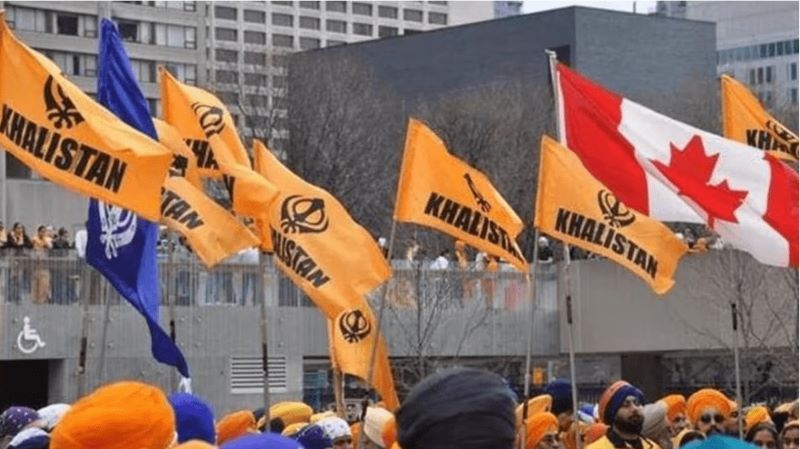
Now, this menace has entrenched itself within Canada’s borders, notably with the activities of groups like Sikhs for Justice (SFJ). The organization of a Khalistan referendum in Surrey, a city that has witnessed its share of Khalistani propaganda, signals a reigniting of radical sentiments that once seemed localized to India. The assassination of Hardeep Singh Nijjar, a known Khalistani advocate, in this very city, underscores the gravity and immediacy of the threat.
The response of the Canadian government, led by Prime Minister Justin Trudeau, has been tepid at best. While Trudeau champions the noble cause of freedom of expression, there appears to be a dangerous reluctance to confront the harsh realities of Khalistani extremism. This soft stance is especially concerning given the violent disruptions at Indian diplomatic missions in London, San Francisco, and Washington, which starkly illustrate the global reach and organized capability of Khalistani radicals.
Canada’s approach to Khalistani extremism is troubling not just for India, but for all nations. The country’s cherished multicultural fabric is being exploited by extremists who use it as a shield to foster an atmosphere of intimidation and violence, far from the eyes of their homeland security. In Surrey, places of worship have been converted into platforms for extremist rhetoric, honoring militants as martyrs and breeding grounds for radicalization. This is not just an Indian problem; it is a Canadian one, and indeed, a global one.
The potential consequences of allowing Khalistani extremism to flourish are dire. If Canada continues to serve as a safe haven for such elements, it risks becoming the epicenter of a renewed, global Khalistani terror campaign. The international community must understand that terrorism knows no borders. Dismissing Khalistan as a regional issue would be a grave miscalculation.
It is imperative that Canada re-evaluates its stance on Khalistan. The government must strengthen its counter-terrorism measures and ensure that its commitment to freedom of expression does not come at the expense of national and international security. Canada must collaborate more closely with international partners, particularly India, to disrupt extremist networks and propaganda machines that operate within its borders.
Freedom of speech is an invaluable right, but it should not provide cover for violent extremism. The balance between safeguarding rights and ensuring security is delicate and complex, but it is a balance that must be struck. Ignoring the rise of Khalistan extremism not only jeopardizes Canadian societal harmony but also poses a significant threat to global peace.
The international community, therefore, must wake up to the reality of this growing threat. We cannot afford complacency in the face of extremism that seeks not just to divide but to destroy. It is a call to action for all nations to unite against the tide of radicalism and to preserve the ideals of peace and security for the world. Let us heed this call before it is too late.
(Photo and text courtesy: Khalsavox.com)
Support Our Journalism
We cannot do without you.. your contribution supports unbiased journalism
IBNS is not driven by any ism- not wokeism, not racism, not skewed secularism, not hyper right-wing or left liberal ideals, nor by any hardline religious beliefs or hyper nationalism. We want to serve you good old objective news, as they are. We do not judge or preach. We let people decide for themselves. We only try to present factual and well-sourced news.
Support objective journalism for a small contribution.