'Why can't citizens protest against the government? They are being made slaves by slapping cases': Bombay HC slams Mumbai Police, quashes activist's externment
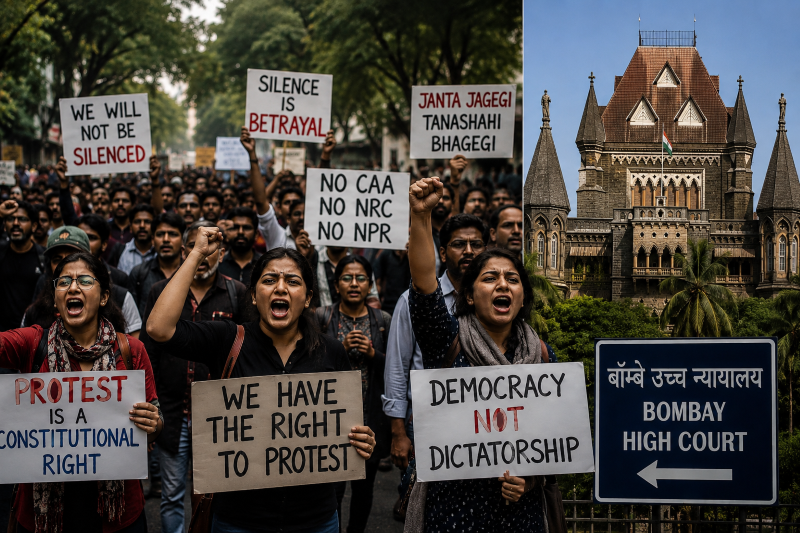
Mumbai/IBNS: The Bombay High Court on Friday came down heavily on the Mumbai Police for issuing an externment order against a political activist, stressing that citizens have the constitutional right to protest and raise slogans against the government.
The court set aside the externment order against 49-year-old Saeed Ahmad Abdul Wahid Chaudhary, who claims to be the general secretary of the Socialist Democratic Party of India (SDPI), observing that the police action was "vitiated" and "mala fide".
What is the case?
Chaudhary challenged the externment order, claiming he had been barred from the area for one year.
According to the petition, the externment proceedings stemmed from a show-cause notice issued in October 2025, based on multiple First Information Reports (FIRs) registered against him between 2019 and 2024 for participating in or organising protests.
Advocates Payoshi Roy and Ibraheem Harbat, appearing for Chaudhary, argued that all the FIRs against their client were registered under Section 188 of the Indian Penal Code (IPC), which deals with disobedience of an order duly promulgated by a public servant.
They submitted that the cases related to protests over issues such as the Citizenship (Amendment) Act (CAA), the National Register of Citizens (NRC), the Babri Masjid dispute and the sealing of the Gyanvapi Mosque, The Indian Express reported.
They contended that none of these activities justified an externment order and sought its cancellation.
Court's sharp observations
Hearing the matter, Justice Madhav J. Jamdar questioned the rationale behind penalising citizens for participating in protests and expressing dissent.
Referring to recent paper leak controversies, the judge remarked that people cannot be prevented from protesting government actions.
"What is this? All citizens are being made slaves of the Indian Government... They cannot stage protests, they cannot agitate—what is all this? Now so many papers have been leaked. If people protest, you will slap cases... What is this?" Justice Jamdar observed, as quoted by Live Law.
The judge also questioned why slogans critical of the government should invite punitive action.
"It is the right of the citizens to protest.... The petitioner has just raised slogans like 'BJP Government Murdabad', 'Amit Shah Murdabad'... Why can't citizens raise such slogans? Why externment orders for such slogans?" the judge said.
Police reminded of constitutional duty
The High Court reminded the police that they are accountable to the people and must act within the framework of the Constitution rather than serve those in power.
Setting aside the externment order, the court held that the police action was legally unsustainable and violated the petitioner's fundamental rights.
The bench reiterated that every citizen has the freedom to express opinions under Article 19 and the right to live with dignity under Article 21 of the Constitution.
Support Our Journalism
We cannot do without you.. your contribution supports unbiased journalism
IBNS is not driven by any ism- not wokeism, not racism, not skewed secularism, not hyper right-wing or left liberal ideals, nor by any hardline religious beliefs or hyper nationalism. We want to serve you good old objective news, as they are. We do not judge or preach. We let people decide for themselves. We only try to present factual and well-sourced news.
Support objective journalism for a small contribution.