 Taslima Nasreen
'Women deserve equal laws': Taslima Nasreen bats for Uniform Civil Code in India, Bangladesh, Pakistan
Kolkata/IBNS: Exiled Bangladeshi author Taslima Nasreen has called for the introduction of a Uniform Civil Code (UCC) in India, Bangladesh and Pakistan, arguing that equal civil laws are essential to end discrimination against women and ensure justice irrespective of religion.
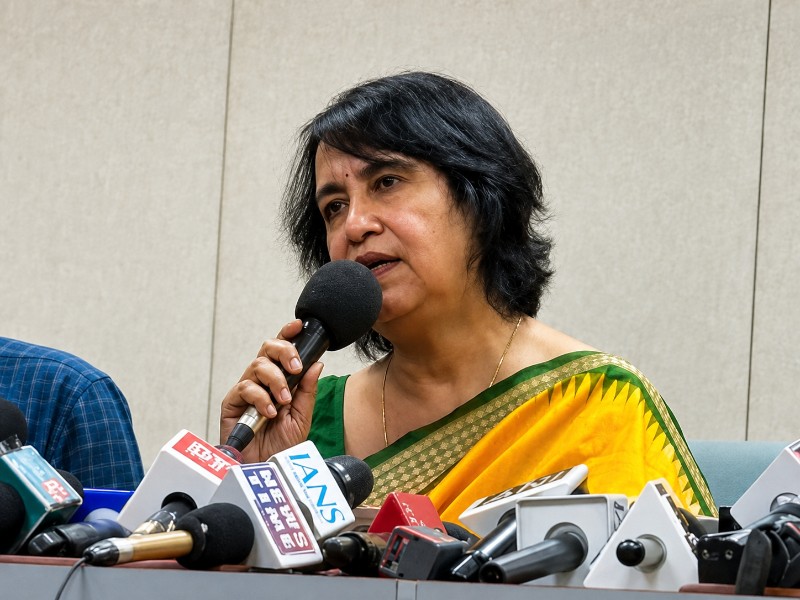
Speaking at a press conference at the Paschim Bangla Akademi in Kolkata on Sunday, Nasreen said all modern democracies should have a common civil code that guarantees equal rights to every citizen.
She maintained that women continue to suffer because of religion-based personal laws and stressed that legal equality was the only sustainable way to address such discrimination.
"All advanced countries have UCC-like laws. Bangladesh, Pakistan and India need a Uniform Civil Code. There should be equal laws for everyone. Women face a great deal of discrimination, and much of it can be removed through a UCC. It is essential," Nasreen told reporters.
Her remarks came a day after West Bengal Chief Minister Suvendu Adhikari assured her of security during her visit to Kolkata, where she returned after nearly 19 years.
'One nation, equal laws'
Expanding on her argument, Nasreen said every civilised nation should have a legal framework that treats all citizens equally, regardless of religion or community.
"I want a Uniform Civil Code. Every civilised country needs one. One nation, one law, equal laws for everyone," she said.
The writer urged India, Bangladesh and Pakistan to adopt such legislation, saying it would significantly strengthen women's rights and remove legal inequalities that continue to exist under different personal laws.
Last month, the BJP-led West Bengal government constituted a high-level committee to examine the possibility of drafting a Uniform Civil Code for the state.
Concern over women's rights in Bangladesh
Nasreen also referred to the condition of women in Bangladesh, particularly those belonging to the Hindu community, claiming they continue to face legal discrimination.
"In Bangladesh, Hindu women do not have equal rights. They cannot inherit their father's property. If Hindu women are to enjoy freedom and equal rights, a Uniform Civil Code is necessary," she said.
The 63-year-old author, who left Bangladesh in 1994 after facing threats from Islamist groups over her writings, has consistently advocated secularism, gender equality and freedom of expression.
Criticism of madrasas and religious extremism
Nasreen strongly criticised religious extremism and expressed concern over what she described as the lack of oversight in many madrasas.
"In many instances, jihadis are produced in madrasas. Some madrasas are factories for creating jihadis. Child abuse and child rape occur in these institutions. Therefore, such madrasas should not exist," she said.
She argued that many religious schools function without adequate government regulation and claimed children are often exposed to intolerance from an early age.
"Some madrasas are factories for creating jihadis. Child abuse and rape often occur in these madrasas. So, such madrasas should not exist. They should be converted into non-religious schools,” exiled Bangladeshi author Taslima Nasreen says in #Kolkata. #TaslimaNasrin… pic.twitter.com/sNpqYB5q0I
— India Blooms (@indiablooms) August 2, 2026
According to Nasreen, successive governments in Bangladesh compromise with religious fundamentalists for electoral gains, allowing extremist ideologies to flourish.
"Many madrasas remain outside effective government control. Children are taught hatred towards non-Muslims from an early age. Governments often compromise with religious extremists for votes. That is why such institutions become breeding grounds for jihadis," she said.
She added that the education system required structural reforms and called for stronger state oversight of religious educational institutions.
'Criticism brings reform'
Reiterating her long-held position on religion and free thought, Nasreen said she criticises religious practices that deny women equality because meaningful reform cannot happen without questioning established traditions.
"I criticise any religion that treats women as sexual slaves. Criticism is necessary. Without criticism, there can be no reform. I was driven out of my country because I dared to criticise," she said.
The author has spent decades living in exile after facing threats over her writings, many of which focus on women's rights, secularism and religious fundamentalism.
Separating literature from politics
Nasreen rejected suggestions that her visit to Kolkata or her public remarks were politically motivated.
"I am not here to speak for any political party, or against any party. I believe in free thinking," she said.
Drawing a comparison with her visits to other Indian states, she said accepting security from a state government should not be interpreted as political support.
"I travel to many states, including Kerala. Does that make me part of that state's politics? Certainly not. Any government providing me security is simply fulfilling its responsibility. It has nothing to do with politics," she added.
Praise for Bengal's new govt
Nasreen nevertheless acknowledged the difference between successive governments in West Bengal, saying she was grateful that the present administration had enabled her return after nearly two decades.
"There is certainly a difference between the three governments. One government forced me to leave, another did not allow me to return, while the third has welcomed me back. Instead of focusing on those differences, I think we should celebrate the fact that I have finally been able to return."
"I am very happy to be here. I want to believe that this government believes in freedom of expression and freedom of speech," she added.
The author also thanked Chief Minister Suvendu Adhikari for ensuring her security during the visit.
"I see nothing political in inviting me back to Kolkata after 19 years. The newly elected government has assured my security during my stay. I thank the Chief Minister for that," she said.
Calls for Sheikh Hasina's return
Nasreen also spoke about the political situation in Bangladesh, describing the ouster of former Prime Minister Sheikh Hasina from office in 2024 as undemocratic.
She urged the Bangladeshi authorities to revoke the ban on the Awami League and allow the party to participate in future elections.
"The ouster of Awami League leader Sheikh Hasina in the way it happened was wrong. It was anti-democratic. Banning the party was absolutely undemocratic. They should be allowed to participate in elections. I want Hasina to return to Bangladesh," she said.
Her comments come against the backdrop of Bangladesh's turbulent political developments following the mass protests of July 2024, which led to the collapse of the Hasina government and her departure from the country.
Support for Chinmoy Krishna Das
The exiled writer also expressed concern over the arrest of former ISKCON leader Chinmoy Krishna Das in Bangladesh, alleging that he had been targeted for speaking up for the country's Hindu minority.
"Chinmoy paid the price for helping Hindus who were in trouble. Many like us are speaking up for Chinmoy. Free thinkers are continuously being targeted. Many of us had no choice but to leave the country," she said.
Nasreen, who has lived in exile since 1994 after facing threats from Islamist groups over her writings, said the shrinking space for free thought remained a matter of concern in Bangladesh.
Joy Goswami incident leaves author 'hurt'
Nasreen also reacted to the disruption during her felicitation programme in Kolkata on Saturday, saying she felt personally hurt after renowned Bengali poet Joy Goswami was prevented from addressing the gathering following protests by a section of the audience.
The controversy began after Nasreen invited Goswami to the stage and requested him to speak.
However, loud objections from some attendees forced the celebrated poet to step down without delivering his address.
"I felt bad. It was not an insult just to Joy, but to me as well because I had invited him. There might be differences of opinion, but everyone has the right to speak. I hope such an incident never happens again," she said.
Return after 19 years
Nasreen's visit marks her first return to Kolkata in almost 19 years.
She lived in the city between 2004 and 2007 before being forced to leave following violent protests over portions of her memoir Dwikhandito (Split: A Life).
After leaving Kolkata in 2007 during the Left Front government, the writer did not return during the Trinamool Congress administration, which came to power in 2011.
West Bengal Chief Minister Suvendu Adhikari warmly welcomes exiled Bangladeshi author Taslima Nasrin to Kolkata during an event at Rabindra Sadan, marking her return to the city after 19 years. #SuvenduAdhikari #TaslimaNasrin #Kolkata pic.twitter.com/hDTViJMkVn
— India Blooms (@indiablooms) August 1, 2026
Her return became possible after the BJP formed the government in West Bengal earlier this year.
She credited the current state administration with ensuring her security and facilitating her visit, while insisting that accepting official protection should not be viewed through a political lens.
Chief Minister's assurance
During a felicitation programme on August 1 organised by the organisation Secular Mission, West Bengal Chief Minister Suvendu Adhikari welcomed Nasreen and assured her of complete security whenever she visits the state.
Presenting her with a portrait of Bankim Chandra Chattopadhyay, Adhikari said West Bengal remained committed to protecting constitutional values and freedom of expression.
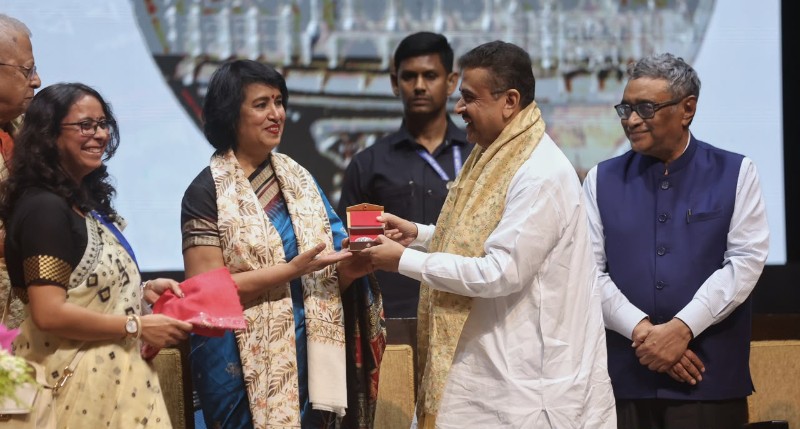 Bengal CM Suvendu Adhikari welcomes Taslima Nasreen back to Kolkata, August 1, 2026. Photo: Avishek Mitra/IBNS
Taslima Nasreen described the assurance as a positive step and reiterated that she hoped every society would protect writers' rights to express themselves freely, irrespective of ideology or religion.
"As I got security assurance from the current government in West Bengal, if everything goes well, I hope I would attend the next Kolkata Book Fair like I used to do previously during my stay in the city," Nasreen said.
"I would love to sit at book fair stalls and interact with readers again," the author added.
Support Our Journalism
We cannot do without you.. your contribution supports unbiased journalism
IBNS is not driven by any ism- not wokeism, not racism, not skewed secularism, not hyper right-wing or left liberal ideals, nor by any hardline religious beliefs or hyper nationalism. We want to serve you good old objective news, as they are. We do not judge or preach. We let people decide for themselves. We only try to present factual and well-sourced news.
Support objective journalism for a small contribution.