 JammuAndKashmirEarthquake
Wooden constructions suit Jammu and Kashmir in view of seismicity: Prof Talat
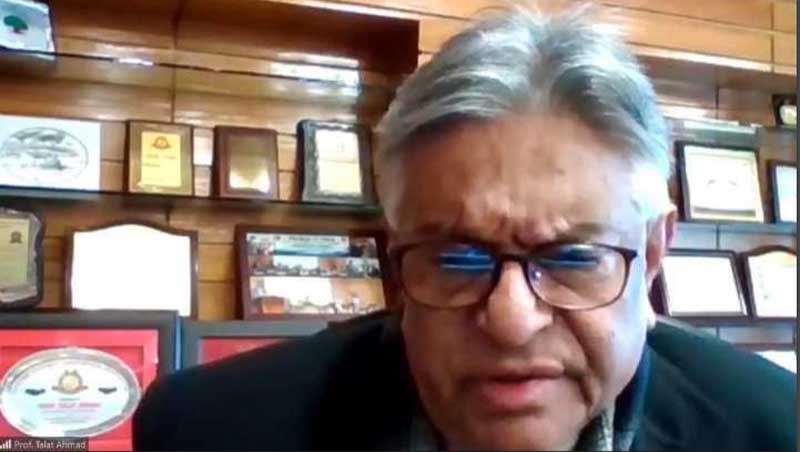
Srinagar: Internationally-acclaimed earth scientist and Vice-Chancellor of University of Kashmir Prof Talat Ahmad on Saturday urged inhabitants and policy-planners of the Himalayan region, including Kashmir, to do away with constructing heavy concrete houses and buildings to minimise casualties during earthquakes.
Addressing as lead speaker a technical session of the ongoing two-week refresher course in science, organised by Kashmir University’s UGC-HRDC, Prof Talat said that wooden houses are best suited for a place like Kashmir since the Himalayan region falls in a high seismic zone.
According to a statement by KU, the VC said houses and buildings in Japan, which experiences high magnitude earthquakes, are largely wooden which gives these structures flexibility to withstand groundshaking which concrete buildings of heavy marbles and limestone cannot do.
“This is why Japan sees fewer casualties during earthquakes,” he said.
Prof Talat said people must learn the ways and techniques to survive properly and not disturb the ecosystem.
“That will be my message to the people,” he said.
He said that greenery and vegetation on mountains were crucial to prevent flooding.
"When the nature gets disturbed by this sort of encroachment, then events like flooding wash off everything. So when you are staying in the Himalayas, you have to be careful in constructing houses,” he said.
He said it is important for States and UTs along the Himalayan region to minimise production of Carbon Dioxide and other gases which lead to rise in temperatures, melting of glaciers and increase in ocean levels. “In that case, there could be flooding all the time,” he said.
“Whatever we do, we have to make sure there’s enough vegetation on land to pull Carbon Dioxide and release Oxygen. If we leave the Earth system alone, it is going to be fine. But with our own activities, we are disturbing the ecosystem and this disturbance needs to be plugged,” he said.
Prof Talat later took several questions from the participants. Asked whether small quakes could avert big ones, he said: “There are gap areas where you have had no earthquakes for the last 500 years or so. But if there is a quake in such an area, that’s going to hit all. It is difficult to predict quakes, but we can hope that with these small quakes, there’s a possibility of big quakes not happening very soon.”
“But with the big systems, like the Himalayas, this is not the case. Though people are working on the earthquake prediction dimension, at present it is impossible to predict quakes given the science and technology that is available,” he said.
Earlier, Course Coordinator and Coordinator UGC-HRDC Dr Geer Mohammad Ishaq, in his welcome address, highlighted Prof Talat’s vast achievements and contributions in academic and research arenas.
“14 lead lectures have been delivered so far, while 20 participants have made their presentation,” he said, thanking the Vice-Chancellor for delivering the special lecture.
Support Our Journalism
We cannot do without you.. your contribution supports unbiased journalism
IBNS is not driven by any ism- not wokeism, not racism, not skewed secularism, not hyper right-wing or left liberal ideals, nor by any hardline religious beliefs or hyper nationalism. We want to serve you good old objective news, as they are. We do not judge or preach. We let people decide for themselves. We only try to present factual and well-sourced news.
Support objective journalism for a small contribution.