


 Nobel Prize Chemistry
2021 Nobel Prize in Chemistry awarded to two scientists for development of asymmetric organocatalysis
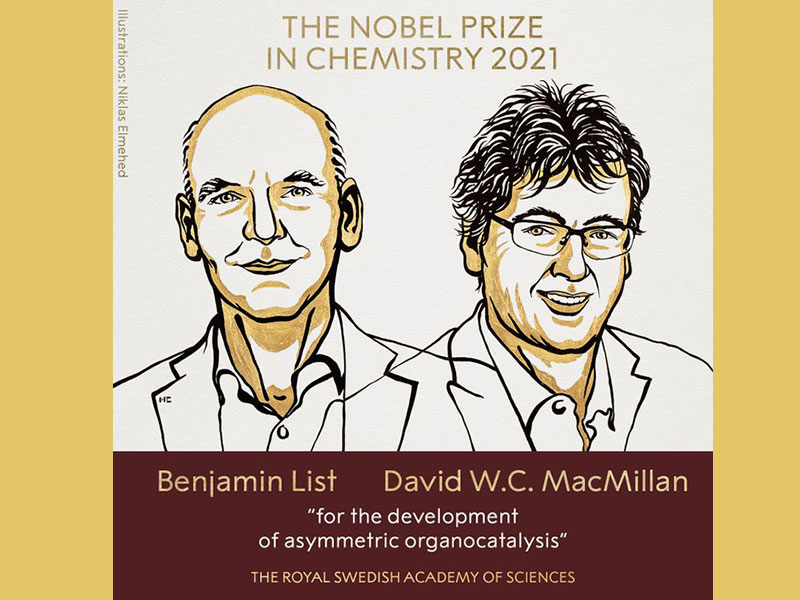
Stockholm: The 2021 Nobel Prize in Chemistry has been awarded to two scientists for the development of asymmetric organocatalysis.
In a statement, the Royal Swedish Academy of Sciences said the prize was given to German-born Benjamin List and Briton David MacMillan this year.
Building molecules is a difficult art. Benjamin List and David MacMillan are awarded the Nobel Prize in Chemistry 2021 for their development of a precise new tool for molecular construction: organocatalysis.
This has had a great impact on pharmaceutical research, and has made chemistry greener.
Many research areas and industries are dependent on chemists’ ability to construct molecules that can form elastic and durable materials, store energy in batteries or inhibit the progression of diseases, read an official statement.
This work requires catalysts, which are substances that control and accelerate chemical reactions, without becoming part of the final product.
For example, catalysts in cars transform toxic substances in exhaust fumes to harmless molecules. Our bodies also contain thousands of catalysts in the form of enzymes, which chisel out the molecules necessary for life.
Catalysts are thus fundamental tools for chemists, but researchers long believed that there were, in principle, just two types of catalysts available: metals and enzymes.
Benjamin List and David MacMillan are awarded the Nobel Prize in Chemistry 2021 because in 2000 they, independent of each other, developed a third type of catalysis. It is called asymmetric organocatalysis and builds upon small organic molecules.
“This concept for catalysis is as simple as it is ingenious, and the fact is that many people have wondered why we didn’t think of it earlier,” says Johan Åqvist, who is chair of the Nobel Committee for Chemistry.
Organic catalysts have a stable framework of carbon atoms, to which more active chemical groups can attach. These often contain common elements such as oxygen, nitrogen, sulphur or phosphorus. This means that these catalysts are both environmentally friendly and cheap to produce.
The rapid expansion in the use of organic catalysts is primarily due to their ability to drive asymmetric catalysis.
When molecules are being built, situations often occur where two different molecules can form, which – just like our hands – are each other’s mirror image. Chemists will often only want one of these, particularly when producing pharmaceuticals.
Organocatalysis has developed at an astounding speed since 2000. Benjamin List and David MacMillan remain leaders in the field, and have shown that organic catalysts can be used to drive multitudes of chemical reactions.
Using these reactions, researchers can now more efficiently construct anything from new pharmaceuticals to molecules that can capture light in solar cells. In this way, organocatalysts are bringing the greatest benefit to humankind.
Support Our Journalism
We cannot do without you.. your contribution supports unbiased journalism
IBNS is not driven by any ism- not wokeism, not racism, not skewed secularism, not hyper right-wing or left liberal ideals, nor by any hardline religious beliefs or hyper nationalism. We want to serve you good old objective news, as they are. We do not judge or preach. We let people decide for themselves. We only try to present factual and well-sourced news.
Support objective journalism for a small contribution.


