


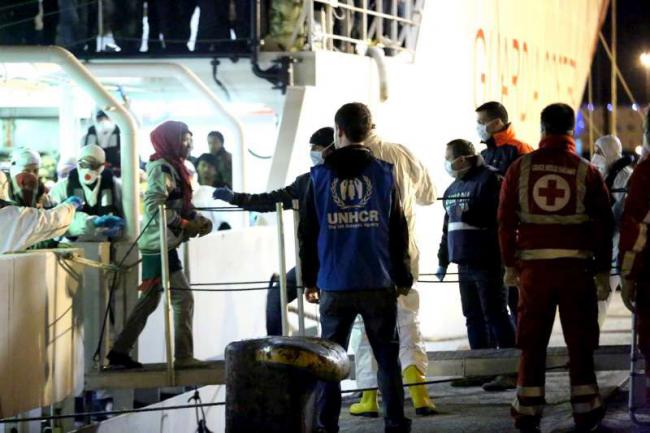
After migrant catastrophe in Mediterranean, UN urges for rescue operations
In a press release issued earlier on Wednesday morning, UN High Commissioner for Refugees António Guterres said he was “deeply shocked” at the capsizing of an overcrowded double-deck boat on 13 April in waters 120 kilometres south of Italy’s Lampedusa Island.
According to UNHCR, 142 people have been rescued by Italian authorities while eight bodies have also been recovered. 400 others are still missing and feared dead.
“This only demonstrates how important it is to have a robust rescue-at-sea mechanism in the central Mediterranean,” Guterres said.
He said, “Unfortunately Mare Nostrum was never replaced by an equivalent capacity to rescue people, and at the same time the legal avenues for those who need protection to be able to come Europe.”
Italy’s ‘Mare Nostrum,’ a major search and rescue programme aimed at saving migrants in the Mediterranean, was replaced in December by the European Union’s current ‘Triton’ operation amid an uptick in sea crossings in the region.
2015, in fact, has already seen some 31,500 people make crossings to Italy and Greece – the first and second largest countries of arrival respectively. UNHCR has reported that numbers have also been recently picking up as weather conditions in the Mediterranean improve.
“For all those in need of protection it is very important to increase the number of resettlement opportunities, humanitarian admission opportunities, to have a more flexible visa policy, to have enhanced family reunification programmes, and to have an effective mechanism to rescue people at sea in the central Mediterranean,” the UNHCR chief added.
The UN refugee agency has been advocating for a comprehensive and urgent response from the European Union and shared specific proposals including the establishment of a possible scheme to compensate shipping companies involved in rescuing people at sea, increasing credible legal alternatives to dangerous voyages and a pilot relocation programme for Syrians refugees arriving in Italy and Greece.
Speaking from Doha, Qatar, where he is presiding over the 13th UN Congress on Crime Prevention and Criminal Justice, Yury Fedotov, the Executive Director of the UN Office on Drugs and Crime (UNODC), added that it was unacceptable that migrants continued to die “in spite of our efforts.”
“It is a crime that needs to be addressed,” Fedotov told the UN in an exclusive interview. “We need to protect the rights of migrants, we need to support them; we need to protect women and especially children.”
He said that it is an urgent priority to introduce measures to protect the human rights of smuggled migrants in accordance with the UN Convention against Transnational Organized Crime and its Protocol against the Smuggling of Migrants by Land, Sea and Air.”
Fedotov also stressed that the international community should confront the criminals and break up their networks. “This means cooperation among nations, inter-governmental organizations and civil society must be strengthened,” he said.
Photo: UNHCR/F. Malavolta
Support Our Journalism
We cannot do without you.. your contribution supports unbiased journalism
IBNS is not driven by any ism- not wokeism, not racism, not skewed secularism, not hyper right-wing or left liberal ideals, nor by any hardline religious beliefs or hyper nationalism. We want to serve you good old objective news, as they are. We do not judge or preach. We let people decide for themselves. We only try to present factual and well-sourced news.
Support objective journalism for a small contribution.


