


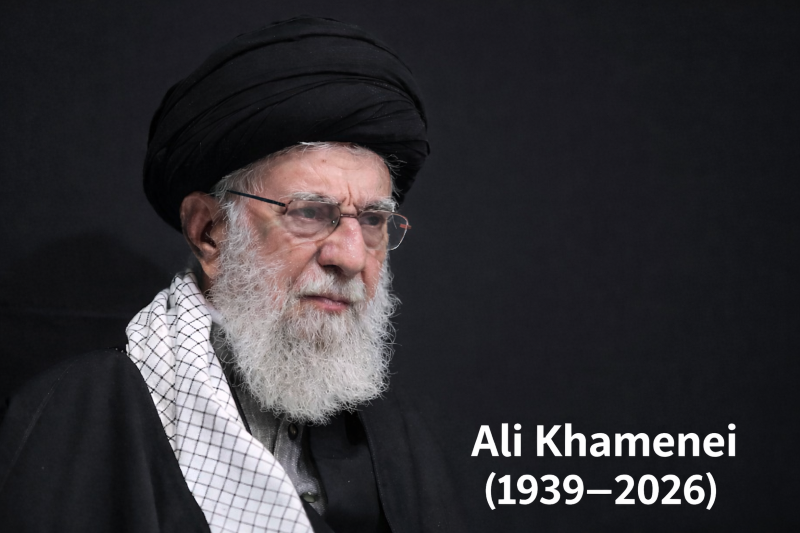
Ali Khamenei (1939–2026): Iran’s Supreme Leader who ruled with an iron grip
Ali Khamenei, Iran’s longest-serving Supreme Leader and the country’s most powerful political and religious authority for over three decades, has died, closing a defining chapter in the Islamic Republic’s history.
Born in 1939 in Mashhad, Khamenei emerged from the clerical networks that opposed the Shah, aligning himself early with revolutionary leader Ruhollah Khomeini.
Arrested multiple times before the 1979 revolution, he built a reputation as a committed ideologue shaped by exile, prison and underground activism.
After the revolution toppled the monarchy, Khamenei rose swiftly through the ranks. He survived an assassination attempt in 1981 that left his right arm paralysed, a moment that burnished his image among supporters as a figure marked by sacrifice.
That same year, he became Iran’s president, serving from 1981 to 1989 during the brutal Iran–Iraq War. Though the presidency carried limits under the Islamic Republic’s structure, the war years deepened his ties with the security establishment.
In 1989, following Khomeini’s death, Khamenei was elevated to Supreme Leader — a role that placed him above elected office-holders and at the apex of Iran’s political system.
His appointment surprised some clerical contemporaries, but he quickly consolidated authority.
Over the decades, Khamenei forged an iron grip on the state. He expanded the influence of the Revolutionary Guards, tightened control over the judiciary and security services, and shaped the direction of parliament and the presidency through the Guardian Council’s vetting powers.
Under his watch, Iran underwent a sustained process of Islamisation in public life. Social codes, media freedoms and cultural expression were closely policed, with reformist waves periodically checked by conservative pushback.
Dissent — from student protests in 1999 to the Green Movement in 2009 and later nationwide demonstrations — was met with firm repression.
Internationally, Khamenei defined himself through resistance to the United States and Israel, casting Iran as the anchor of a regional “axis of resistance.” Tehran expanded its footprint through allied militias and political movements across Iraq, Syria, Lebanon and Yemen.
Yet his tenure also saw moments of tactical flexibility. He cautiously backed negotiations that led to the 2015 nuclear deal under President Hassan Rouhani, though he remained publicly sceptical of Western intentions and later supported a more hardened posture after the agreement frayed.
At home, economic hardship — exacerbated by sanctions and domestic mismanagement — tested the system he presided over.
Still, Khamenei retained ultimate authority, balancing factions while ensuring that no rival centre of power eclipsed the Supreme Leader’s office.
In death, Ali Khamenei leaves behind a deeply polarised nation and a region shaped by his strategic doctrine. His legacy — a blend of ideological steadfastness, centralised control and regional ambition — will weigh heavily on Iran’s uncertain next chapter.
Support Our Journalism
We cannot do without you.. your contribution supports unbiased journalism
IBNS is not driven by any ism- not wokeism, not racism, not skewed secularism, not hyper right-wing or left liberal ideals, nor by any hardline religious beliefs or hyper nationalism. We want to serve you good old objective news, as they are. We do not judge or preach. We let people decide for themselves. We only try to present factual and well-sourced news.
Support objective journalism for a small contribution.


