


 UN
UN
Alleged reprisals and intimidation against 240 who cooperated with UN
Allegations of reprisals and intimidation were documented against some 240 civil society members, activists and journalists, across 45 countries in the year up to 31 April, simply because they had been cooperating with the United Nations.
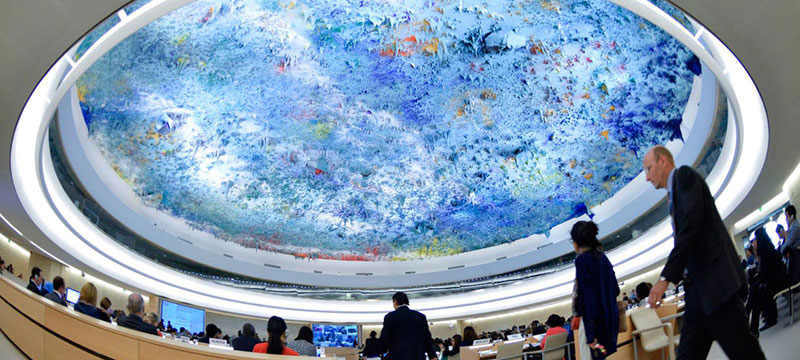
That’s according to data from a new report presented on Wednesday to the Human Rights Council by the UN Assistant Secretary-General for Human Rights, Ilze Brands Kehris.
Many cases were reported anonymously, because of fear of reprisal. There were also around 50 individuals who experienced detention, while others were subjected to house arrest.
Despite some push-back, Ms. Brands Kehris said the report “makes clear” that “the scope and severity of cases of intimidation and reprisal persist and in unacceptably high numbers.”
From surveillance to restrictive legislation
Based on the findings of the report, she highlighted four main trends.
First, in close to half of the countries, there are allegations of monitoring and surveillance, both online and offline, of individuals and groups. Numerous cases include hacking of accounts, travel bans and other movement restrictions.
Second, several UN actors have addressed repeated or similar allegations of intimidation and reprisals to those raised in this and earlier reports. Ms. Brands Kehris highlighted signs of a possible pattern in several countries including China, Egypt, Iran, Saudi Arabia and Viet Nam, where there are serious issues with the detention of victims of reprisals and intimidation, as well as India, Israel, Myanmar, the Philippines, and Venezuela.
Third, she highlighted restrictive legislation, usually on grounds of national security, including counter-terrorism measures, or based on laws governing activities of civil society organizations.
False ‘threats’
“Let me be clear,” Ms. Brands Kehris said. “Claiming women’s rights before a UN body is not an act of terrorism and speaking up in UN fora on the rights of minorities or indigenous peoples is not a threat to national security.”
Fourth, and lastly, she described “increasingly challenging, or even at times repressive, environments for victims, human rights defenders, journalists and other civil society actors.”
For the Assistant Secretary-General, there is “a worrisome trend” where the organization is asked to report on a case where the alleged victim seeks anonymity. Out of the 240 individuals referred to in the report, more than 100 are not mentioned by name, due to protection issues.
A UN priority
These victims continue to be subjected to serious human rights violations, such as arbitrary arrests and detention, but also torture and ill-treatment, and even death in custody, killing and enforced disappearances.
In the digital sphere, activists and journalists have been attacked on social media after speaking at UN meetings, and victims targeted for submitting information or communicating electronically with the organization.
Ms. Brands Kehris also pointed out some examples of good practice by Member States, such as considering and preparing for the risks or any backlash that civil society briefers to the Security Council may face. She also called States’ responses to allegations presented to them in the preparation of the report overall, “encouraging.”
She concluded saying that the Member States should not “tolerate those who bring critical perspectives to us, being silenced.”
“We need to do more and better to provide safe and open spaces for interaction, where those who speak up can be heard without fear of any sort of retribution,” she added.
Support Our Journalism
We cannot do without you.. your contribution supports unbiased journalism
IBNS is not driven by any ism- not wokeism, not racism, not skewed secularism, not hyper right-wing or left liberal ideals, nor by any hardline religious beliefs or hyper nationalism. We want to serve you good old objective news, as they are. We do not judge or preach. We let people decide for themselves. We only try to present factual and well-sourced news.
Support objective journalism for a small contribution.


