


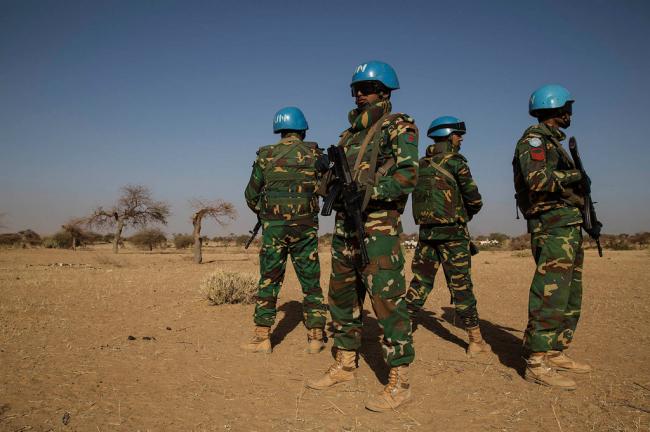
Ban outlines role for Security Council in strengthening peace operations
“[Peace operations] are struggling to implement complex mandates. Our systems are straining at the scale of operations. We are not always responding with the speed and effectiveness required. We have difficulty in keeping pace with the evolution of each conflict,” said Ban in a briefing to the Council as the 15-member body considers the recommendation of his high-level panel on Peace Operations and implementation report.
“We are finding it harder to end conflicts and to sustain peace,” he continued, stressing that strengthening peace operations will require a collaboration of many actors, including the UN Secretariat, Member States, General Assembly and the Security Council.
He said that the recommendations made by the Panel covered three areas, namely political engagements, design and implementation of UN peace operations and reinvigorated partnerships.
Noting that peace operations are deployed to advance and support a political settlement to a conflict and that political engagement even before authorization of a peace operation is crucial, the Secretary-General said that a central finding of the review is that prevention is the most effective means of tackling the escalating costs of conflict.
Committed efforts among Council members to unite around a shared political strategy to de-escalate tensions can have a powerful effect.
He emphasized that the engagement of the Security Council with host governments in also critical to ensure that they fulfil their obligations with regard to the safety, security and freedom of movement of uniformed peacekeepers and civilian staff.
At the same time, Ban acknowledged that timely information is crucial to acting on issues early and reaffirmed his commitment to provide the Council with frank and timely briefings on situations of escalating concern, particularly those situations where civilians are at grave risk.
“Regional offices and my special envoys are invaluable in supporting early and effective political engagement. My Human Rights Up Front initiative seeks to focus the attention of the UN system on the prevention of serious and large-scale violations of human rights,” said Ban.
Further, the Secretary-General stressed the need for better design and implantation of operational mandates, including tailoring mandates based on the specific conflict environment in order to increase adaptability if conflicts evolve.
He also said that the UN Secretariat will aid in providing better and more regular assessments of conflicts and crisis and added that he has implemented measure to strengthen UN analysis and planning at Headquarters, field missions and across the UN system.
“The Council has a responsibility to ensure that peacekeepers are equipped to carry out their tasks. This means ensuring that we have the range of capabilities required for increasingly complex and dangerous modern peace operations,” added Ban.
“Equally, we need your engagement when things do not go well. Where UN peace operations have a mandate to protect civilians, they must use all tools, including, where necessary, the use of force. But this does not replace the search for political settlements; it makes your engagement more critical,” stressed the Secretary-General.
He added that the Council would be informed if there is a failure to act in the face of threats to civilians and requested the Council members to ‘engage, politically and operationally, to help redress such situations.’
Additionally, Ban called for stronger dialogue with partners of the Security Council, which is “for devising more tailored mandates and strengthening the Council’s political engagement.”
Deeper engagement with regional partners is “a must,” he said calling on the Council to institutionalize consultation and dialogue, and where appropriate, collaborate in planning and conducting peace operations.
At the same time, he underlined the need for better relationship between the Council and troop and police contributors and with the Peacebuilding Commission, as this is “fundamental to effective peace operations.”
“We need deeper understanding of our respective expectations, capacities and constraints. We need to engage well before a peace operation is mandated on what is required and what is available. I welcome the Council’s recent dialogue with contributing countries, and I encourage you to consider my proposals for further strengthening triangular consultations,” said Ban.
In conclusion, the UN chief pointed out that if implemented, these efforts “can enable us to renew the instruments of the United Nations to address conflict, protect people and help countries find durable paths of peace.”
Photo MINUSMA/Marco Dormino/www.justearthnews.com
Support Our Journalism
We cannot do without you.. your contribution supports unbiased journalism
IBNS is not driven by any ism- not wokeism, not racism, not skewed secularism, not hyper right-wing or left liberal ideals, nor by any hardline religious beliefs or hyper nationalism. We want to serve you good old objective news, as they are. We do not judge or preach. We let people decide for themselves. We only try to present factual and well-sourced news.
Support objective journalism for a small contribution.


