


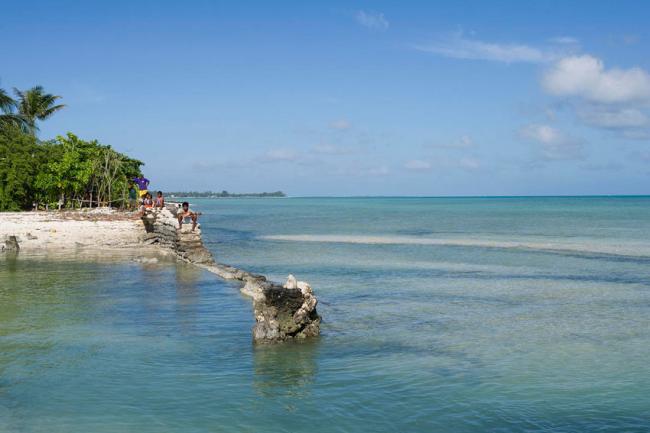
Climate change threatens self-determination of citizens in island States
The President of Kiribati and the Prime Minister of Tuvalu were joined by Deputy UN High Commissioner for Human Rights Flavia Pansieri, who opened the discussion, telling the Geneva-based Council that human-induced climate change is not only an assault on the world’s shared ecosystem but it also undercuts “the rights to health, to food, to water and sanitation, to adequate housing and, for the people of small island states and coastal communities, even the right to self-determination.”
The spokesperson for the Office of the UN High Commissioner for Human Rights (OHCHR), Rupert Colville, briefed the press on the discussions, saying that continued sea level rise at their current rate, could result in low-lying Pacific Island States, including Kiribati and Tuvalu being submerged within decades.
He noted that some citizens have already been forced from their homes, while the two Governments struggle to supply people with adequate supplies of food and clean drinking water.
According to a Government minister from Kiribati who briefed the Council in January, preparations are underway for a time when climate change “refugees” might exist. The Government of Kiribati has been buying land offshore and providing people with the skills to “migrate with dignity” when their islands were no longer habitable, Colville said.
Survival is one thing but if the islands of Kiribati and Tuvalu do disappear, the spokesperson said, gone with them will be all the trappings of a modern state, Government buildings, courts, hospitals and schools. That will undermine those States’ peoples’ right to self-determination.
Their leaders will have to find ways of reconstituting their States elsewhere, or persuade another government to provide their citizens with passports, welfare and protection. If they can’t do this, these “climate change refugees” will become stateless.
“We are calling for human rights standards to be put front and centre of discussions on mitigating the negative impacts of climate change,” said Colville.
She said, “Any action designed to limit climate change must have people’s rights at its core. This should be taken into account when the UN Climate Change Conference convenes in Paris later this year to draw up a new global agreement.”
Photo: UN Photo/Eskinder Debebe
Support Our Journalism
We cannot do without you.. your contribution supports unbiased journalism
IBNS is not driven by any ism- not wokeism, not racism, not skewed secularism, not hyper right-wing or left liberal ideals, nor by any hardline religious beliefs or hyper nationalism. We want to serve you good old objective news, as they are. We do not judge or preach. We let people decide for themselves. We only try to present factual and well-sourced news.
Support objective journalism for a small contribution.


