


 Afghanistan
Displaced Afghans face ‘continued deterioration’ in country
The situation for people who have been displaced due to an upsurge in fighting in Afghanistan following the resurgence of the Taliban is expected to continue to deteriorate, unless more is done to assist them, according to the UN’s International Organization for Migration (IOM).
The IOM estimates that more than 300,000 Afghans have been internally displaced by the recent intensification of the conflict and in June some 40,000 people a week fled to neighbouring Iran.
Coming home
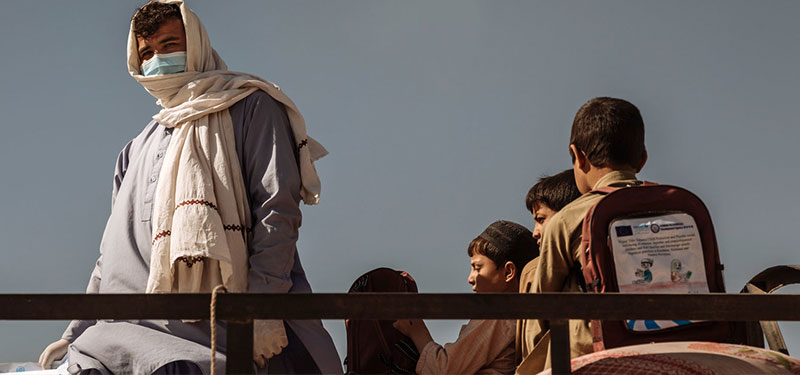
Meanwhile, despite the significant dangers posed to civilians, more people are returning home from outside the country. One of them is Mustafa (not his real name) who fled Afghanistan 15 years ago due to insecurity.
He worked as a motorcycle mechanic in Pakistan until the effects of a struggling economy, compounded by the COVID-19 pandemic and increasing xenophobia, forced him to close his business late last year.
“I did not have a good life in Pakistan and now I’m back in Afghanistan. All I wish for is a small home and the chance for my children to get an education. If they can go to school this will be the biggest accomplishment of my life,” said Mustafa at the Spin Boldak border point on the Afghan-Pakistan frontier, one of nine major border points which has been captured by the Taliban in recent weeks.
Over the past few months, the Taliban has been carrying out a major nationwide offensive in the wake of the withdrawal of foreign troops.
Deportations
Since the beginning of the COVID-19 pandemic, more than 1.5 million people have been deported from, or opted to leave, neighbouring Pakistan and Iran to return to Afghanistan. And people like Mustafa continue to return despite the territorial gains made by the Taliban.
The returnees need food, clothes, rent for a new house as many have lost their homes, and payment to cover transportation to their final destination. Many are being supported by the IOM.
“The situation in Afghanistan is worsening daily from every perspective”, according to Stuart Simpson, IOM Afghanistan Chief of Mission. “Now is not the time to turn a blind eye to Afghanistan’s critical situation. International attention and advocacy is urgently needed to convey the suffering of Afghan civilians to the world. A negotiated ceasefire remains the best solution for Afghanistan’s civilian population to stay safe and potentially create the conditions for improved service delivery and the access required to reach vulnerable persons with care and assistance”.
Shrinking humanitarian space
The UN estimates that almost half the Afghan population, 18.5 million people, will require humanitarian support in 2021 to cope with the multifaceted crisis, caused by conflict, COVID-19 and widespread under-development and poverty.
However, as fighting intensifies and spreads, the operating space for humanitarians providing life-saving assistance continues to shrink dramatically.
“IOM will ensure we are prepared for a continued deterioration in the humanitarian situation”, said Stuart Simpson. “We will do our utmost to keep our programming up and running through targeted access negotiations with parties to the conflict to allow critical interventions to move ahead but only insofar as we can guarantee the safety of our staff”.
Attacks on health workers
The conflict has accelerated attacks on healthcare workers across the country and led to closure of hundreds of health facilities, which has critically impacted the country’s fight against COVID-19.
Given that the movement of people is the primary driver of COVID-19 transmission in Afghanistan, sizeable cross border returns have acted as a catalyst for transmission against a backdrop of poor access to vaccines.
“The availability of the COVID-19 vaccine in Afghanistan is extremely low”, said IOM Afghanistan chief Stuart Simpson. “This country of 40 million people has received just over 3 million doses. Vaccine hesitancy is still high and equitable distribution of available doses remains a major challenge”.
‘I belong to this country and it belongs to me’
As Afghanistan becomes increasingly insecure, one reality is clear: communities across the country will continue to move in search of peace, security, jobs and services.
“When I crossed the gates back into my home country of Afghanistan, I started crying because I am now back in my country with my children for the first time,” said Mustafa.
“Even if there is war and fighting here and even if I’m struggling, I would prefer to be home. I belong to this country and it belongs to me”.
Support Our Journalism
We cannot do without you.. your contribution supports unbiased journalism
IBNS is not driven by any ism- not wokeism, not racism, not skewed secularism, not hyper right-wing or left liberal ideals, nor by any hardline religious beliefs or hyper nationalism. We want to serve you good old objective news, as they are. We do not judge or preach. We let people decide for themselves. We only try to present factual and well-sourced news.
Support objective journalism for a small contribution.


