


Full-fledged UN peacekeeping mission in Somalia would be 'high-risk undertaking,' Security Council told
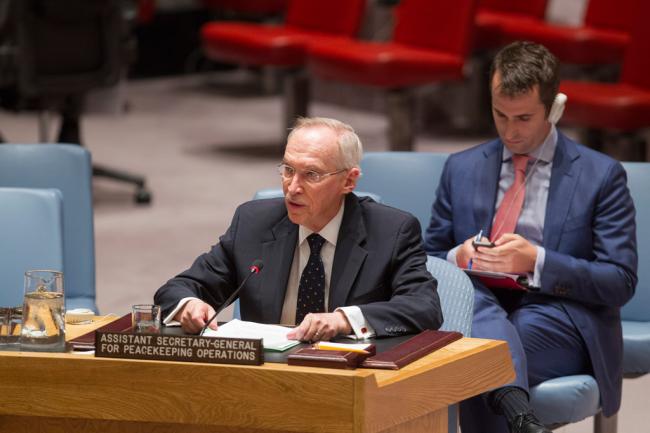
“Progress would not have been possible without the continuing sacrifices of AMISOM troops and the Somali National Army. Their heroism deserves our collective tribute,” saidEdmond Mulet, the UN Assistant Secretary-General for Peacekeeping Operations, attributing the significant gains made against Al Shabaab to a surge of AMISOM military personnel and to the logistical support package for the Somali National Army.
“However, in the face of these advances, A1 Shabaab continued to adapt, launching asymmetric attacks and blocking access to some of the newly recovered areas. It also expanded its presence in Puntland and became a more significant threat within the sub-region,” warned Mulet.
Underlining the importance of the extension of State authority throughout the Somali territory, the Assistant Secretary-General said that the international community should engage in Somalia in accordance with the new federal map.
The recommended strategy was designed to create an enabling environment for the political process to unfold in Mogadishu and the regions during the next critical 18 months, and would be guided by three interlocking objectives: enabling the political process at all levels; reinitiating offensive operations against Al-Shabaab strongholds as soon as possible; and enabling consolidation efforts.
Those objectives, he said, required strong commitments from all partners, including the Somali Federal Government, the African Union, troop-contributing countries and the United Nations.
While improving AMISOM’s efficiency and effectiveness, the surge in uniformed personnel should be maintained until the end of 2016, as recommended by the Secretary-General, he said, welcoming the African Union Peace and Security Council’s decision to reconfigure the Mission within the authorized ceiling.
Ultimately, “the proposed security strategy would only succeed if Somali security institutions were supported and able to progressively assume greater responsibility for their own security,” Mulet said.
To that end, it is important to devise an enhanced and more coherent architecture for international partners to deliver capacity-building support to the national army and the country’s defence sector. In that regard, he highlighted, the adoption of the “Guulwade” Plan for the development of the army on 23 April was a critical step forward.
A gradual shift of efforts towards establishing and capacitating the Somali police force is equally critical, he said, noting that the development of effective and accountable forces, particularly in the regions, should be accelerated.
Adding that the security of Puntland should not be forgotten, the Assistant Secretary-General recommended extending the non-lethal support package to 3,000 Puntland forces on an exceptional basis until the end of 2016, but only upon completion of their integration into the Army, as well as their formal inclusion in the “Guulwade” Plan.
UN Photo/Loey Felipe
Support Our Journalism
We cannot do without you.. your contribution supports unbiased journalism
IBNS is not driven by any ism- not wokeism, not racism, not skewed secularism, not hyper right-wing or left liberal ideals, nor by any hardline religious beliefs or hyper nationalism. We want to serve you good old objective news, as they are. We do not judge or preach. We let people decide for themselves. We only try to present factual and well-sourced news.
Support objective journalism for a small contribution.


