


Genocide occurs when 'warning signs' ignored, action not taken – UN deputy chief
“It is important that we examine why we continue to fail to prevent mass atrocities, despite lessons learned, despite knowledge of causes and drivers and despite our assurances of ‘never again,’” he said. “Genocide can only happen when we ignore the warning signs – and are unwilling to take action.”
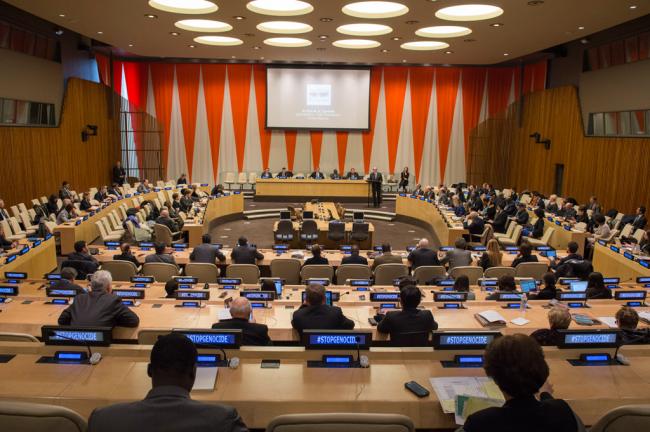
The event, held at UN Headquarters in New York and organized by the Permanent Mission of Poland to the UN and chaired by Boguslaw Winid, preceded the annual International Day of Commemoration of the Victims of the Holocaust.
The permanent representatives to the UN of the United States, Russia, the United Kingdom, France, Rwanda, Israel and Germany were among those who spoke, with the Secretary-General’s Special Advisor on Genocide, Adama Dieng, Philippe Bolopion of Human Rights Watch and Robert Kostro, who is Director of the Museum of Polish History.
Eliasson said the event offered a chance to consider what must be done differently to protect people and build societies ‘where tolerance trumps hatred,’ and stressed that excuses for turning a blind eye were disappearing, with pervasive instant communication and deepening international connections, as well as the knowledge that genocide results from creeping processes unfolding over time and of conditions that allow them to thrive.
“Our challenge is to stop these processes and their enabling conditions at an early stage,” Eliasson said, adding that armed conflicts often create environments right for mass atrocities but stressing that genocide also resulted from divisions fostered in peace time.
The idea that the international community must stand ready to protect populations from genocide and other atrocity crimes was reinforced by adoption of the ‘Responsibility to Protect’ principle at the 2005 World Summit and more needed to be done to operationalize that commitment.
“We need political will, and political courage, to move forward,” he said, pointing out that the UN was engaged in a process of bolstering its capacity to act early through the Secretary-General’s Human Rights Up Front initiative, which promoted better coordination and decision-making.
The Director of the Memorial and State Museum Auschwitz-Birkenau, Piotr Cywinski, delivered the keynote address to the meeting, noting that it was probably one of the last anniversaries that would give the chance to host survivors. Cywinski said it was an important moment to look to the future and form a vision for the memory of the Holocaust.
Auschwitz on Wednesday served as ‘testimony, symbol, and a place for education,’ he said, describing the camp’s history and significance, and the Museum’s efforts to reach out to a younger generation.
Cywinski said protection of the site’s authenticity for younger, less connected audiences was an essential part of his duties and he was working hard to fuse the words of remaining survivors with the physical site where the killing took place.
The representative of Rwanda described the overlap between the events of 70 years ago and of 20 years ago in his own country, asking, in the context of the ‘never again’ pledge made after the Holocaust, why another genocide was allowed to happen.
The year 2015 marked 70 years since the Holocaust, he said but was also 70 years since the creation of institutions that were designed to save succeeding generations from the scourge of war. The question was whether those institutions were strong enough to prevent atrocities in the future and he underlined the importance of political will and implementation of decisions and principles like the Responsibility to Protect.
UN Photo/Eskinder Debebe
Support Our Journalism
We cannot do without you.. your contribution supports unbiased journalism
IBNS is not driven by any ism- not wokeism, not racism, not skewed secularism, not hyper right-wing or left liberal ideals, nor by any hardline religious beliefs or hyper nationalism. We want to serve you good old objective news, as they are. We do not judge or preach. We let people decide for themselves. We only try to present factual and well-sourced news.
Support objective journalism for a small contribution.


