


 Middle East
I wouldn’t take life insurance: Benjamin Netanyahu’s warns Iran’s Supreme Leader Mojtaba amid Middle East tension
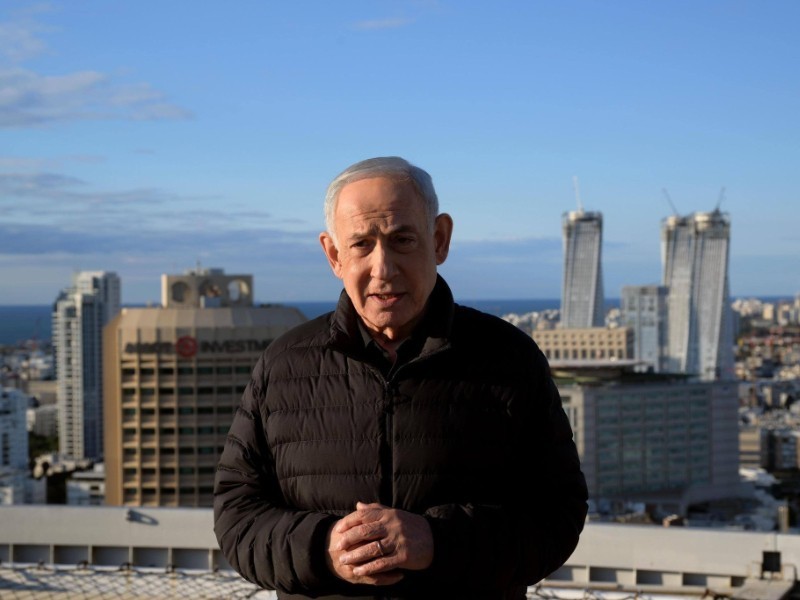
Israeli Prime Minister Benjamin Netanyahu on Thursday issued a veiled threat against Iran’s new supreme leader, Mojtaba Khamenei, days after he was elected to lead the country amid the ongoing Middle East crisis.
“I wouldn’t take out a life insurance policy on any of the leaders of the terror organizations,” Netanyahu said, according to The Times of Israel.
The Israeli prime minister also said he was uncertain whether the Iranian people would overthrow the Islamic Republic if Israel and the United States created conditions that might enable such a move.
“You can lead someone to water; you cannot make him drink,” Netanyahu said during a press conference quoted by the newspaper.
The remarks came during Netanyahu’s first press briefing since the February 28 attack launched by Israel and the United States on Iran.
“We will create optimal conditions to do this, including airstrikes as we did yesterday and as we are doing these days, to try to give the Iranian people the space needed to take to the streets,” he said.
“We are delivering crushing blows to the Islamic Revolutionary Guard Corps and the Basij, their street forces and checkpoints — and more is yet to come,” Netanyahu added.
At the same time, he acknowledged that regime change in Iran remains uncertain.
“I do not deny it: I cannot say for certain that the Iranian people will bring down the regime,” Netanyahu said. “We are all hoping for the result of this regime falling.”
UN warns of soaring humanitarian costs
Meanwhile, the United Nations’ emergency relief chief on Wednesday warned about the escalating humanitarian and economic toll of the Middle East conflict.
Tom Fletcher condemned the “$1 billion-a-day” cost of the war, warning that the growing crisis is unfolding at a time when global humanitarian needs are surging while aid funding continues to fall short.
“We’re seeing the consequences spread faster than we can respond,” Fletcher told reporters in Geneva, adding that the violence is triggering cross-border instability, mass displacement and severe economic shocks.
Describing the situation as “a moment of grave peril,” he warned that without additional funding, “millions of people will die.”
Over $14 billion still needed
A $23 billion humanitarian appeal launched last December by the United Nations to assist 87 million of the world’s most vulnerable people remains roughly two-thirds underfunded.
Fletcher explained that although far more people require aid globally, the 87 million identified represent those in the most urgent need of assistance.
“We still need over $14 billion now to deliver this plan, and this is at a time when conflict in the Middle East is costing $1 billion a day,” he said. “Even just $1 billion would allow us to save millions of lives.”
He added that Gaza Strip and Sudan are currently at the top of the list in terms of urgent humanitarian funding needs.
Strait of Hormuz concerns
Fletcher’s remarks also come amid growing concern over the impact of the closure of the Strait of Hormuz, one of the world’s most critical shipping routes.
The corridor, which handles around 20 percent of global oil shipments, has significant implications for global markets.
Fletcher warned that disruptions could sharply increase food, energy and fertilizer prices worldwide, worsening humanitarian conditions.
“I’m worried that further escalation could damage other supply routes as well,” he said. “All of this has a direct impact on our humanitarian supplies, including those going to areas of urgent need in sub-Saharan Africa.”
Support Our Journalism
We cannot do without you.. your contribution supports unbiased journalism
IBNS is not driven by any ism- not wokeism, not racism, not skewed secularism, not hyper right-wing or left liberal ideals, nor by any hardline religious beliefs or hyper nationalism. We want to serve you good old objective news, as they are. We do not judge or preach. We let people decide for themselves. We only try to present factual and well-sourced news.
Support objective journalism for a small contribution.


