


Liberia making progress on numerous fronts, UN official tells Security Council
“Liberia is making progress on a number of fronts, including important momentum on essential political reforms,” Under-Secretary-General for Peacekeeping Operations Hervé Ladsous said, as he presented the latest report on the UN Mission in Liberia (UNMIL).
Several months ago, the Liberian Government launched a “deconcentration” programme, which Ladsous described as a “critical first step” in decentralizing State reach so that local officials are empowered and citizens throughout the country are able to benefit from the most basic of services.
In addition, in August, President Ellen Johnson-Sirleaf transmitted to the Legislature 25 proposed amendments emerging from a constitutional review process, along with her recommendations.
“The President categorically rejected, and suggested that Liberia’s elected representatives should also reject, exclusionary provisions such as declaring Liberia a Christian nation or requiring African ancestry for citizenship,” Ladsous noted.
He added, “The recommendations also included proposed changes that the President supported, such as shorter terms for elected officials, including presidents and legislators.”
Meanwhile, at this time last year, Liberia was dealing with an unprecedented health emergency due to the Ebola virus outbreak, which devastated communities and threatened to reverse the political and security gains made since the end of the civil war.
“Fortunately, the country has since turned a corner,” Ladsous said.
He added, “The people of Liberia endured the trauma of Ebola with resilience, dignity and a profound determination to overcome.”
Indeed, efforts were rewarded when on 3 September Liberia was declared Ebola-free for the second time by the UN World Health Organization (WHO).
Furthermore, Ladsous informed the Council that the security situation remains generally stable, though public order is reportedly still a source of concern.
This was echoed by Liberia’s Minister of Justice and Attorney General, Benedict F. Sannoh.
“The [UN] Secretary General has expressed concern about the recent surge in violent public disturbances and has linked this to deficiencies in the response capacity of the national police, public discontent, alienation and slow pace of reconciliation,” the Minister stated.
He said, “However, the violence alluded to are isolated incidents which relate to motorcyclists, and few concession areas. They need to be taken in context.”
The UN peacekeeping chief underlined that the Government remains committed to making every effort to mobilize the resources needed to develop its capacity to maintain stability and protect its population independently of UNMIL.
He recalled that last April, the Security Council decided to resume the progressive drawdown of UNMIL, which had been suspended during the Ebola crisis.
“UNMIL has been reduced by 1,221 troops, reaching this month its new military strength of 3,590 personnel,” he noted.
He added, “The Secretary-General has recommended further reductions to UNMIL’s military, police and civilian components, taking into account the Security Council’s expectation that the Government of Liberia will be fully responsible for security as of 30 June 2016.”
He added that it would be important for UNMIL to retain the capacity to provide support for some months after the conclusion of the security transition to test the capability of Liberian security personnel to protect civilians and respond to security incidents, in order to mitigate any risk of reversal.
The Under-Secretary-General also drew the Council’s attention to the deployment on Monday of Farid Zarif, the Secretary-General’s new Special Representative for Liberia. He is succeeding Karin Landgren, who completed her assignment last July.
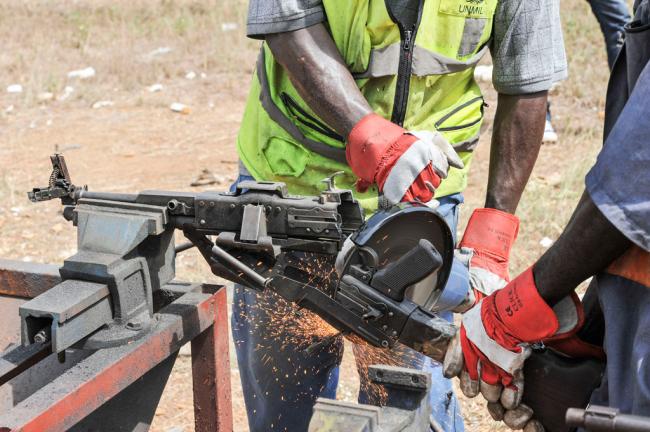
Photo: UNMIL Photo/Emmanuel Tobey
Support Our Journalism
We cannot do without you.. your contribution supports unbiased journalism
IBNS is not driven by any ism- not wokeism, not racism, not skewed secularism, not hyper right-wing or left liberal ideals, nor by any hardline religious beliefs or hyper nationalism. We want to serve you good old objective news, as they are. We do not judge or preach. We let people decide for themselves. We only try to present factual and well-sourced news.
Support objective journalism for a small contribution.


