


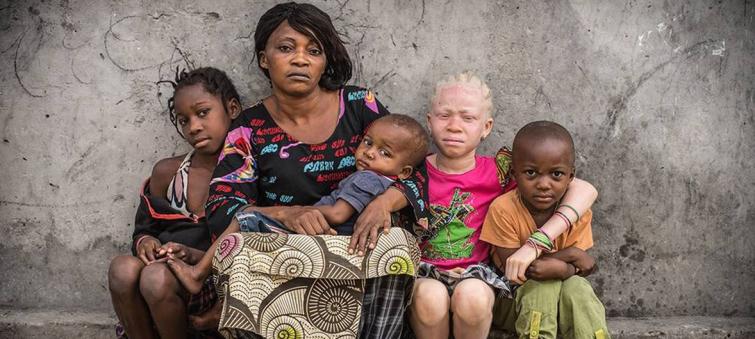
Making education safe for children with albinism in Malawi
New Yok/IBNS: In Malawi, where children with albinism face attacks, and even ritual killings, going to school can expose them to life-threatening dangers. The UN is helping to make schools safer for these vulnerable students.
Chinsisi Jafali, a 14-year-old with albinism, knows that going to school is a risky prospect, but it’s a risk he’s prepared to take. “I have six siblings who are all looked after by my mother,” he says. “Fending for the entire family has been exceptionally difficult for my mother. Her fight for our survival motivates me to go to school and work hard, so that I can help my family in future.”
One in 130 people in Malawi has albinism, over 134,000 in total. Of these, 40 percent (about 53,000) are of primary and secondary school age. Yet going to school potentially puts them in grave danger. In some communities they are attacked or even killed for their body parts which are erroneously believed to possess magical powers. In the last five years, over 160 cases of killings, and other human rights violations against persons with albinism have been reported in the country, with similar cases also occurring in neighbouring Tanzania and Mozambique.
“Some parents are so afraid of sending their children with albinism to school that fewer children with albinism access education,” says Maria Jose Torres, the United Nations Resident Coordinator, the most senior UN humanitarian official in Malawi. She also points out that, with many of them visually impaired, a lack of schools offering special needs education also limits their chances of receiving a quality education.
Fighting for survival, and schooling
Despite their plight, many boys and girls with albinism are defying the odds to remain in school in search for a brighter future. Chinsisi, who is from Kunaunje Village in Salima district in the Central Region of Malawi, is one of these brave children.
When Chinsisi lost his father at age 4, many people in his village thought his future was over. Being raised by a single mother in a poor family was always going to be difficult, particularly with small-scale subsistence farming as their only tangible means of livelihood.
Ten years on Chinsinsi is now studying at a primary school in the district: normally, at his age, he should have been finishing primary education, but it is not uncommon in Malawi to have older children in lower grades due to dropping out, starting school late, repeating classes, and inadequate learning support.
“I repeated some classes because I was struggling to learn with my sight problem. I couldn’t clearly see things that teachers were writing on the board. But now I sit in front and teachers write in bigger letters than before so that I can read properly. My performance in class has been improving, which makes me feel good,” he says.
Thanks to a collaboration between the school and the community, as part of the Joint Programme on Girls Education (JPGE), supported by the United Nations and Norwegian Government, pupils like Chinsisi now study in a safer environment. This has involved engaging the school, local community and police in efforts to stop violence against girls, and children with albinism.
They have also been teaching the students how to protect themselves: as part of the programme, Chinsisi and other students with albinism received an alarm device for alerting people and security authorities when they face attacks. “I used to be very afraid when going to school and struggling to concentrate on my studies before I received the alarm. Now this is one of my weapons against any threat that comes to me,” he says.
“Children with disabilities used to have poor attendance and poor performance, but that has changed,” says the school’s headteacher, Vincent Selemani. “Chinsisi is one of the students benefiting from an improved and safer learning environment. He is now able to walk from his home and stay at school without worrying about his safety.”
Education is not a luxury, it is a right
“For any child, anywhere, education is not a luxury. It’s a necessity and fundamental right regardless of their status”, says the UN’s Ms. Torres. “Educating girls and children with albinism helps us leave no one behind.”
“Education creates entrepreneurs, a skilled workforce, more consumers and more prosperous communities. A healthy, educated, empowered adolescent girl, or child with albinism has the unique potential to break the cycle of poverty for herself, her family and her country.”
Since the programme has been running, supporting schools in Salima, Dedza and Mangochi districts, school dropouts have fallen from around 16 per cent, to about five percent. As well as stopping violence, and raising the quality of learning, the programme, provides school meals to students like Chinsisi, who would otherwise go hungry, and promotes access to youth-friendly sexual and reproductive health services to reduce teen pregnancies.
Support Our Journalism
We cannot do without you.. your contribution supports unbiased journalism
IBNS is not driven by any ism- not wokeism, not racism, not skewed secularism, not hyper right-wing or left liberal ideals, nor by any hardline religious beliefs or hyper nationalism. We want to serve you good old objective news, as they are. We do not judge or preach. We let people decide for themselves. We only try to present factual and well-sourced news.
Support objective journalism for a small contribution.


