


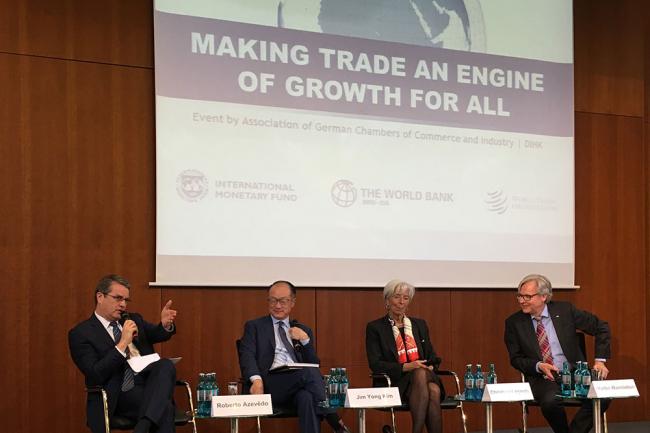
National policies can offset impact of joblessness caused by market competition – UN partner report
Trade leads to productivity gains and significant benefits for consumers, especially the poor, but can also be responsible for job displacement that must be addressed through sound domestic policies that can help the unemployed get back on their feet, say economists from the World Trade Organization (WTO), the International Monetary Fund (IMF) and the World Bank.
“I recognize that there are very real concerns, but the answer is not to turn against trade, which would harm us all,” says the WTO Director-General Roberto Azevêdo.
Economists from the three global organizations reflect in the report on the latter part of the 20th century, arguing that trade integration helped drive economic growth in advanced and developing economies through greater productivity, increased competition resulting in higher living standards and more choices and better prices for consumers.
Looking back, “trade has had a very positive impact on the lives and livelihoods of many millions of people in recent decades,” says Azevêdo.
The report notes that job losses in certain sectors or regions in advanced economies have resulted to a large extent from technological changes rather than from trade.
According to Mr Azevêdo the “challenge before us is to support the workers of on Monday and train the workers of tomorrow.”
The organizations call on national governments to pursue both “active” and “passive” labour market policies such as training programmes, job search assistance and wage insurance (a private insurance providing compensation if one is forced to move to a job with a lower salary) to facilitate reintegration of the unemployed back into the job market.
The organizations also call on governments to stabilize unemployed working families with short term passive labour market programmes, such as unemployment benefits and income support until those who have lost their jobs can get back to work.
Effective education and skills policies will be essential in preparing workers for the changing demands of the modern economy, they add.
The report also calls for further trade integration to strengthen global growth and advance an inclusive trading environment.
It stresses that traditional areas such as agriculture need further attention, while sectors such as services, as well as digital trade, represent areas where further trade reform can make a particularly strong contribution to growth.
Photo: WTO
Source: www.justearthnews.com
Support Our Journalism
We cannot do without you.. your contribution supports unbiased journalism
IBNS is not driven by any ism- not wokeism, not racism, not skewed secularism, not hyper right-wing or left liberal ideals, nor by any hardline religious beliefs or hyper nationalism. We want to serve you good old objective news, as they are. We do not judge or preach. We let people decide for themselves. We only try to present factual and well-sourced news.
Support objective journalism for a small contribution.


