


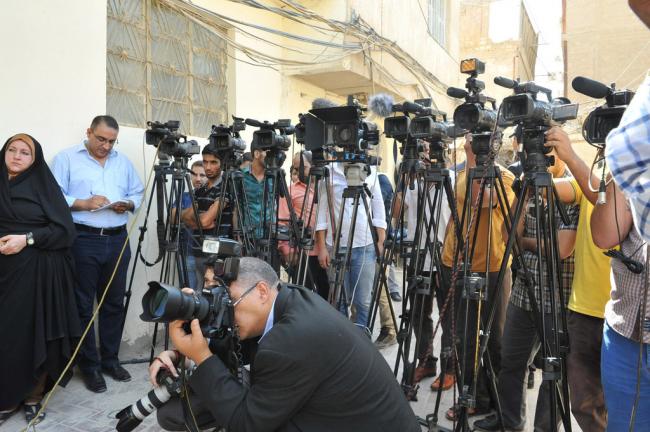
New law a ‘direct attack’ on free expression in Maldives, UN rights expert warns
“Criminalizing speech on such vague and broad grounds as set out in the Bill is a direct attack on the exercise of the right to freedom of expression in the Maldives,” David Kaye, UN Special Rapporteur on the promotion and protection of the right to freedom of opinion and expression, said on Wednesday in a news release issued by the Office of the UN High Commissioner for Human Rights (OHCHR).
“Freedom of expression is a fundamental right and any restrictions on it must be narrowly and objectively defined, not a matter of common routine,” he stressed.
On 9 August, the country’s Parliament adopted the ‘Protection of Reputation and Good Name and Freedom of Expression Bill,’ which criminalizes speech deemed to be defamatory, to comment against ‘any tenet of Islam’, to ‘threaten national security’ or to ‘contradict general social norms’.
Those committing an offence under the bill can face fines, and failure to pay, will result in jail sentence of three to six months.
Kaye further added that the broad grounds for restrictions in the Bill contradict not only international human rights standards recognised by the Maldives, such as the International Covenant on Civil and Political Rights, but also the its own Constitution, which protects the right to freedom of expression.
“The use of religion as a ground for limiting free speech is particularly worrying,” he cautioned, emphasizing that international human rights law protects individuals from discrimination and violence based on their religion or belief, but it does not protect religion or belief from comment or criticism as such.
The Special Rapporteur also expressed that the Bill will have a “strong chilling effect” on media and civil society, making reporting and criticism truly risky.
“The threat of additional penalties for the media are likely to lead to even greater self-censorship on issues perceived to be sensitive, limiting public debate on issues of public interest and depriving society from accessing important information on sensitive affairs,” said Kaye.
Noting that he would be eager to engage in discussion with the Maldivian authorities on the law, the rights expert expressed hope that “the President will reverse the decision by sending back the bill to Parliament for further review in consultation with independent institutions, journalists, civil society organisations and human rights defenders and bring it in compliance with international human rights standards.”
UN Special Rapporteur on the rights to freedom of peaceful assembly and of association, Maina Kiai, and the Special Rapporteur on the situation of human rights defenders, Michel Forst, also shared the concerns expressed by Kaye and endorsed his statement.
They had also co-signed a letter to the national authorities detailing their concerns about the legislation on 26 May 2016.
Special Rapporteurs are appointed by the UN Human Rights Council to examine and report back on a specific human rights theme or a country situation. The positions are honorary and the experts are not UN staff, nor are they paid for their work.
Photo: UNAMI
Source: www.justearthnews.com
Support Our Journalism
We cannot do without you.. your contribution supports unbiased journalism
IBNS is not driven by any ism- not wokeism, not racism, not skewed secularism, not hyper right-wing or left liberal ideals, nor by any hardline religious beliefs or hyper nationalism. We want to serve you good old objective news, as they are. We do not judge or preach. We let people decide for themselves. We only try to present factual and well-sourced news.
Support objective journalism for a small contribution.


