


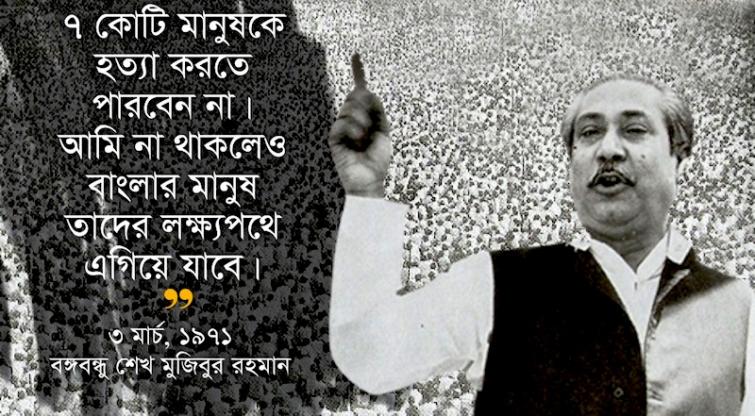
 Bangabandhu
New White Board magazine issue highlights the relevance of Bangabandhu’s policies to today’s development
Dhaka: White Board, a newly launched policy magazine, has highlighted the policies of Bangabandhu Sheikh Mujibur Rahman which has helped in shaping up Bangladesh in its first issue published recently.
The magazine's issue aims to make the youth of Bangladesh aware about the policies of the iconic Bangladeshi leader and founder of the nation.
The magazine created a space for the experts who either worked with Bangabandhu on formulating policies or possess ample knowledge of that matter.
Speaking on the magazine, writer Sujon Mondal wrote in his opinion piece published in bdnews24: "The publication gave me the perspective that while youths observe today’s development and progress, they hardly recall that the seed of those developments was sown by Bangabandhu over four decades ago."
Take the case of the write-up by Julian Francis who has worked with the extreme poor in Bangladesh and India, with nearly 30 years in Bangladesh. Under his close look at the post-independence policies, he offered some practical insight into how Bangabandhu envisioned the developmental roadmap of a war-ravaged country, Mondal wrote in the opinion piece.
Referring to the fact that the Father of the Nation had to start everything from scratch, Julian wrote, “During the war, all communication, social and industrial infrastructure had been targeted. Transportation networks had been destroyed – bridges, roads, culverts, railways, and waterways. More than 300 rail and road bridges had been demolished. The damage done in the transportation and communication sector was estimated at USD 160 million.
"The main trading hub, Chittagong Port, had been ruined. Nearly 22,000 educational institutions, including 18,000 primary schools, had been damaged. The cost to public assets stood at USD 350 million. The challenges before Mujib were thus huge, especially in the early phase of the reconstruction process. The government took up this Herculean task along with its development partners.”
Julian also mentioned that Bangabandhu pinned his hope on waterways as the lifeline of the country’s connectivity.
He directed the purchase of three truck-carrying ferries that, even 45 years into their purchase, ply the Padma river at Mawa.
"There was a sea of issues Mujib had to deal with within a handful of years. Having witnessed the inaction of the previous regime of Pakistan during the 1970-cyclone leaving hundreds of thousands of countrymen dead, he led his administration to formulate a disaster management plan including the construction of climate-resilient rural housing as well as flood/cyclone centres in disaster-prone areas," Mondal wrote.
Centre for Policy Dialogue (CPD) Chairman Rehman Sobhan and Fellow Rounaq Jahan jointly penned a commentary titled ‘Mujib’s economic policies and their relevance today’.
They highlighted how Mujib came up with policy directions including filling ‘the policy-making vacuum by setting up a National Planning Commission and the Bangladesh Bank within two days of his return to Bangladesh on 10 January 1972’.
They also shed light on Mujib’s vision to ensure a just and egalitarian society where people from all walks of life including peasants and workers also receive their fair share.
As revealed by the magazine’s editor-in-chief Radwan Mujib Siddiq, this issue is a tribute to the Father of the Nation on his birth centenary. The upcoming issues will cover COVID-19 and Bangladesh@50.
Support Our Journalism
We cannot do without you.. your contribution supports unbiased journalism
IBNS is not driven by any ism- not wokeism, not racism, not skewed secularism, not hyper right-wing or left liberal ideals, nor by any hardline religious beliefs or hyper nationalism. We want to serve you good old objective news, as they are. We do not judge or preach. We let people decide for themselves. We only try to present factual and well-sourced news.
Support objective journalism for a small contribution.


