


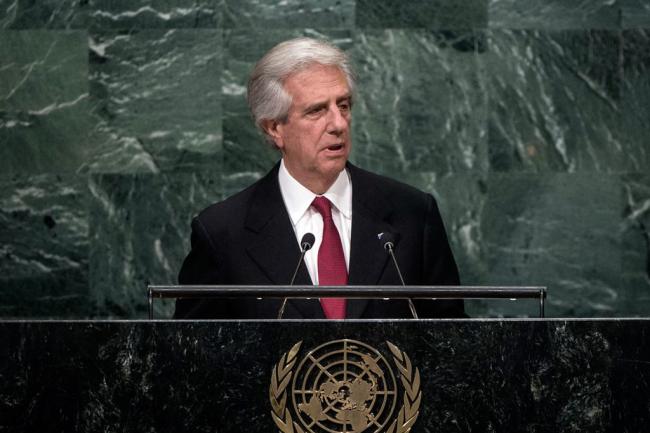
Non-communicable diseases ‘make poverty even worse,’ Uruguay President warns UN Assembly
“These diseases, to a great extent, result from four risk factors directly related to supposedly typical behaviours of modern lifestyle: smoking, alcoholism, unhealthy diet and sedentary lifestyle,” said President Tabaré Vázquez, who came into the political circle from the medical profession.
According to available data, he said, 104,109 individuals will die on Tuesday as a consequence of non-communicable diseases highly related to the risk factors.
“This is not a medical panel or a scientific symposium” but he must tell that it is not only possible to design and implement tobacco control and other effective strategies, but also achieve positive results.
“Vicious circles are easily formed in these populations: poverty exposes people to behavioural risk factors of non-communicable diseases and in turn, these diseases tend to make poverty even worse,” he said.
He warned that unless the epidemics of non-communicable diseases are strongly fought against, the global goal of poverty reduction – an indispensable condition for sustainable development – will move farther away every day, he said, citing the direct cost of smoking on Latin-American health systems at $33 billion, and the economic cost of cancer in Mexico, the Caribbean, and Central and South Americas at $286 billion.
Uruguay is a world leader in the implementation of the World Health Organization (WHO) Framework Convention on Tobacco Control, he said.
However, he added, there have been immense challenges, such as a claim brought by Phillip Morris against his country’s regulations to control smoking. In a final settlement decision, the policies adopted by Uruguay were recognized as sovereign, legitimate and respectful of the international commitments undertaken by the country and of international law, he said.
That company’s “main reason was to punish a small country which has decided to control tobacco consumption” as a warning to all. The best way to move forward is to invite all countries to implement Framework Convention with “no fear of threats or retaliations from powerful tobacco companies.”
Turning to other issues, he commended Colombia for having reached a peace agreement with the Revolutionary Armed Forces of Colombia – People’s Army (FARC-EP), and urged the lifting of the embargo imposed by the United States on Cuba.
Underlining the essential need for everyone to adhere to the 2030 Agenda for Sustainable Development, he said the Paris Agreement on climate change had been the first step taken by States to demonstrate their commitment to reducing emissions and diminishing global temperatures.
He welcomed the New York Declaration on Refugees and Migrants adopted yesterday by UN Member States, and said that Uruguay would remain committed to UN peacekeeping, adding that it would continue to contribute thousands of personnel to operations.
Vázquez is among the many leaders who will address the general debate of 71st General Assembly. The Assembly's high-level segment opened this year with the adoption of the New York Declaration as the outcome of yesterday's first-ever UN Summit for Refugees and Migrants. Made up of all the 193 Member States of the United Nations, the Assembly provides a forum for multilateral discussion of international issues covered by the UN Charter.
UN Photo/Kim Haughton
Source: www.justearthnews.com
Support Our Journalism
We cannot do without you.. your contribution supports unbiased journalism
IBNS is not driven by any ism- not wokeism, not racism, not skewed secularism, not hyper right-wing or left liberal ideals, nor by any hardline religious beliefs or hyper nationalism. We want to serve you good old objective news, as they are. We do not judge or preach. We let people decide for themselves. We only try to present factual and well-sourced news.
Support objective journalism for a small contribution.


