


 Security Council
Security Council veto should be ‘very last resort’: General Assembly President
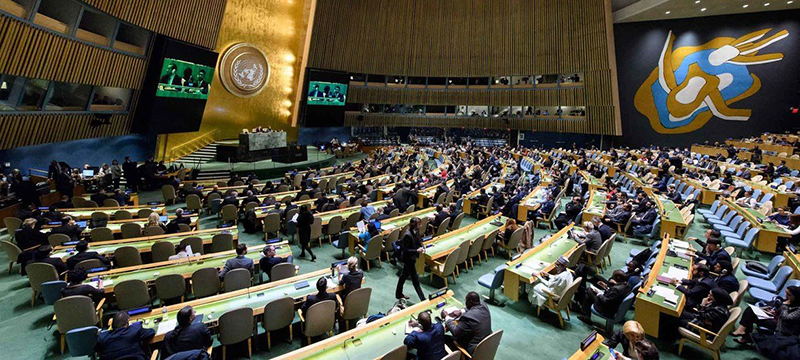
New York: One year after the General Assembly adopted its so-called “veto initiative”, Member States met on Wednesday to discuss how it could contribute to a more efficient and impact-oriented UN.
The landmark resolution, adopted by consensus, calls for the General Assembly to automatically meet within 10 days if any of the five permanent members of the Security Council – China, France, Russia, the United Kingdom and the United States – uses their right of veto.
The aim is to hold these countries accountable for exercising this special voting power, which allows them to block any Council resolution or decision.
This right is enshrined in the UN Charter, the Organization’s founding document, because of their key roles in establishing the global body more than seven decades ago.
All five have exercised the right of veto at one time or another, with 44 vetoes alone since the year 2000.
A new instrument
In his opening remarks, General Assembly President Csaba Kőrösi said “the issue of the use of the veto affects the whole UN. And the decisions taken in these halls – or the lack of decisions – reverberate world-wide,” adding that “vetoes should always remain the very last resort.”
He said this first-ever formal debate on the veto initiative was being held “to figure out the best ways to exploit this new instrument in our big UN toolbox.”
He urged ambassadors to “ask tough questions” and “seek game-changing solutions”, stressing that “there is no wrong answer, only new ideas.”
‘Like an oxygen mask’
Mr. Kőrösi also expressed hope that Security Council members can unite and work for viable solutions, going beyond their immediate interests to act responsibly for the sake of peace across the world.
“That way we will never have to fall back on the veto resolution,” he said. “Because, in my view, it is like an oxygen mask in an airplane: good to have, but best never to be used.”
The General Assembly President said he intends to send the verbatim records of the debate, and all future debates, to the Council President.
“Today’s exchange of views cannot be just a pro forma event, or a mere administrative procedure,” he said.
“This is an opportunity to chart new avenues for multilateralism and cooperation. An opportunity to rebuild trust both within our institution and in it. An opportunity to do better for the eight billion who count on us.”
Support Our Journalism
We cannot do without you.. your contribution supports unbiased journalism
IBNS is not driven by any ism- not wokeism, not racism, not skewed secularism, not hyper right-wing or left liberal ideals, nor by any hardline religious beliefs or hyper nationalism. We want to serve you good old objective news, as they are. We do not judge or preach. We let people decide for themselves. We only try to present factual and well-sourced news.
Support objective journalism for a small contribution.


