


 Libya
Libya
Tensions rise in Libya as risk of ‘parallel governments’ grows, Security Council hears
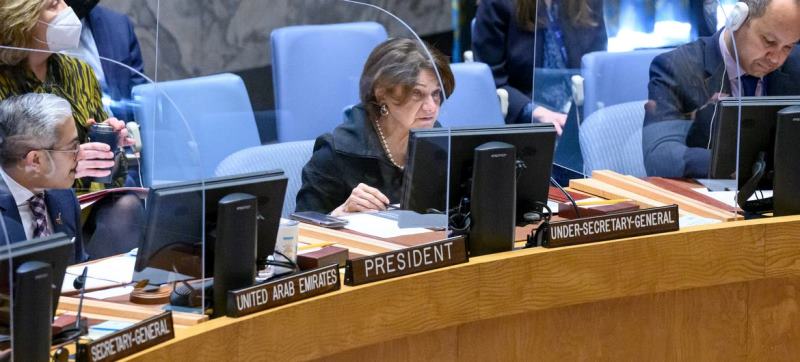
New York: Amid a political impasse that threatens to see Libya fractured again by two parallel governments, the priority must be maintaining hard-won gains and fulfilling the electoral aspirations of nearly three million registered voters, the UN political affairs chief told the Security Council on Wednesday.
Rosemary DiCarlo, Under-Secretary-General for Political and Peacebuilding Affairs, also spotlighted an increase in reported human rights violations, hate speech, defamation and threats, as well as violence against activists, journalists and political actors.
“Libya is now facing a new phase of political polarization, which risks dividing its institutions once again and reversing the gains achieved over the past two years,” she warned.
Political impasse
Outlining recent developments, the Under-Secretary-General recalled that Libya’s last planned elections — scheduled for December 2021 — were postponed, with the country’s National Elections Commission citing inadequacies in electoral legislation and challenges related to candidates’ eligibility.
In February, the country’s eastern-based House of Representatives voted to designate a new Prime Minister and government, over the objections of the internationally recognized Prime Minister, Abdul Hamid Dbeiba, who refused to step down.
Nevertheless, the House of Representatives went forward with the formation of a new government, designating Fathi Bashagha, a former Minister of Interior, as the new Prime Minister.
On 24 February, the High State Council - based in the internationally recognized administration’s centre of government in Tripoli and born out of the UN-supported Libyan Political Agreement of 2015 - rejected the parliamentary declaration, setting up a serious impasse that is now once again ramping up tensions in the conflict-wrought nation.
East v West: ‘joint committee’ proposal
On 3 March, members of Mr. Bashagha’s cabinet were sworn in by the House of Representatives.
While the situation on the ground remains relatively calm, reports are emerging of threatening rhetoric, rising political tensions and divided loyalties among the armed groups in western Libya.
“Our priority is to focus on fulfilling the aspirations of the more than 2.8 million Libyans who have registered to vote,” Ms. DiCarlo told the Security Council.
She added: “They should be able to choose their leaders through credible, transparent, and inclusive elections according to an agreed upon constitutional and legal framework.”
Against that backdrop, the Secretary-General’s Special Adviser, Stephanie Williams, has proposed the formation of a joint committee comprising members of the House of Representatives and the High State Council, with the goal of reaching agreement on a constitutional basis that would lead to elections in 2022.
Ms. Williams also continues to pursue consultations with a broad cross section of Libya’s political and security actors and civil society, and has offered her good offices to mediate between Abdul Hamid Dbeibah and Mr. Bashagha.
Economic, human rights challenges
Ms. DiCarlo also briefed the Council on Libya’s ongoing security, economic and human rights challenges, warning that the latter have seen a spike as tensions rise across the country.
On the economic front, she highlighted a lack of oversight and clarity on public spending, noting that no national budget was approved in 2021 and a roiling controversy over budgetary payments is hampering the functioning of Libya’s National Oil Corporation.
She pointed to rise in hate speech, defamation and threats, as well as incitement to violence and acts of violence against activists, journalists and political actors, including women.
Both State and non-State actors arbitrarily arrest and detain human rights activists, and migrants and refugees at sea continue to be intercepted by Libya’s authorities and transferred to detention centres where they reportedly suffer serious human rights violations.
Citing reports of torture, starvation, extortion and deaths in custody, she nevertheless said the UN recorded a decrease in the number of internally displaced persons across Libya, between the end of 2021 and 5 March.
Support Our Journalism
We cannot do without you.. your contribution supports unbiased journalism
IBNS is not driven by any ism- not wokeism, not racism, not skewed secularism, not hyper right-wing or left liberal ideals, nor by any hardline religious beliefs or hyper nationalism. We want to serve you good old objective news, as they are. We do not judge or preach. We let people decide for themselves. We only try to present factual and well-sourced news.
Support objective journalism for a small contribution.


