


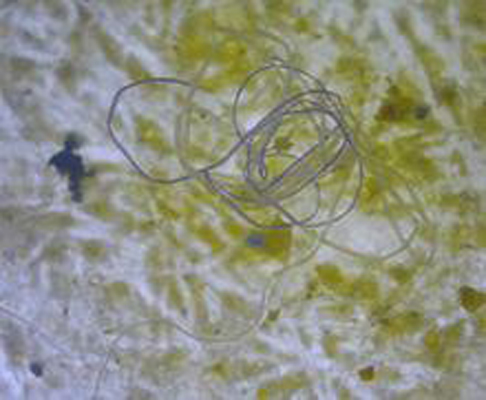
Toronto: Microplastics found in supermarket fish, shellfish
These findings were part of a report prepared for the International Maritime Organization, the UN agency responsible for preventing marine pollution.
The report said that it had not yet been established what effect these small particles of plastic will have on the humans who consume them.
Chelsea Rochman, an assistant professor of ecology and evolutionary biology at the University of Toronto and co-editor of the report said that researchers were aware of different sources through which microplastics get into aquatic habitats.
'It has infiltrated every level of the food chain in marine environments … and so now we're seeing it come back to us on our dinner plates,' said Chelsea Rochman, University of Toronto ecologist, CBCNews reports said.
These range from tiny fibres, bits of car tire that wear off on roads and make their way through storm drains into waterways, said Rochman.
They also vary in size and could be easily consumed by both big and microscopic marine animals.
"It has infiltrated every level of the food chain in marine environments and likely fresh water, and so now we're seeing it come back to us on our dinner plates," said Rochman, CBCNews reports said.
Peter Wells, a senior research fellow with the International Ocean Institute at Dalhousie University said, "These materials enter marine organisms, not just their guts but also their tissues," CBCNews reports said.
Wells said that the stuff that comes along with the plastics poses a threat.
Microplastics absorb or carry organic contaminants, such as PCBs, pesticides, flame retardants and hormone-disrupting compounds of many kinds, Wells said.
Wells said that until recently, the world's attention was on larger pieces of plastic in the ocean that was visible to the naked eye.
"Only when scientists started looking at plankton and water samples more carefully did they realize that a lot of the plastic was being broken down, not seen except under a microscope," said Wells, CBCNews reports said.
Among all the microplastics in our lakes and oceans, microbeads — those little exfoliants from facial scrubs and hand soaps — are the best known by the public.
"Microbeads are really what brought microplastics to the table in Canada as something that we would regulate and monitor," said Rochman. CBCNews reports said.
A federal government ban on toiletries containing microbeads will come into effect in 2018.
However, these are not the main source of microplastics, she said.
Microbeads, like these from a sample of toothpaste seen under a microscope, are the best known among microplastics but not the most common source, says Chelsea Rochman, co-editor of the report.
"The biggest source is likely larger plastic items that we can see during beach cleanups that enter the water and over time break down with the sunlight into smaller and smaller pieces of microplastic,” said Rochman, CBCNews reports said.
Think plastic bags, styrofoam takeout containers and plastic cutlery, said Rochman.
Kate Comeau, a registered dietitian and the spokeswoman for Dietitians of Canada said,
"It's an important conversation," says Comeau, "but we don't want people running away from eating healthy sources of food."
Fish is an excellent source of protein, she says. "The fatty fish are also a great source of vitamin D, which we don't have a lot of food sources of in our Canadian diet. Fish is also a great source of iron, and those omega-3 fats are really important in terms of our heart health."
Rochman stressed that more research is needed in this.
"What we really need to do is a risk assessment … nobody has done that for microplastics," CBCNews reports said.
(Reported by Asha Bajaj, Image of Microplastics: Wikipedia)
Support Our Journalism
We cannot do without you.. your contribution supports unbiased journalism
IBNS is not driven by any ism- not wokeism, not racism, not skewed secularism, not hyper right-wing or left liberal ideals, nor by any hardline religious beliefs or hyper nationalism. We want to serve you good old objective news, as they are. We do not judge or preach. We let people decide for themselves. We only try to present factual and well-sourced news.
Support objective journalism for a small contribution.


