


UN calls for increased food security measures to offset threat of 'shocks'
In his address to the 41st session of the Committee on World Food Security (CFS), José Graziano da Silva, Director-General of the UN Food and Agriculture organizations (FAO) told participants that while progress against hunger continues, “it is a society – not a Government – that decides to eradicate hunger and achieve food security.”
“Political commitment and leadership from governments is the first step,” declared Graziano da Silva. “However, civil society, private sector and other non-state actors also need to embrace this goal. At the global level the CFS promotes an enabling environment for this to happen.”
The CFS meets annually to take stock of progress on reducing food insecurity in the world, and to map out key policy objectives over the course of the year. It reports to the Economic and Social Council of the United Nations (ECOSOC).
In this year’s session, two policy roundtables will tackle looming food security-related issues as highlighted in the latest report produced by the High Level Panel of Experts on Food Security and Nutrition, including food losses and waste, which currently amount to one-third of food produced worldwide, and the contribution made by fish to food security and to healthy diets.
Among the more pressing matters tied to food losses, CFS participants are expected to debate the matter of improved labelling and other forms of information for producers and consumers which are considered as efficient methods in curbing waste.
Meanwhile, amid a 12-fold increase in farmed fish production over the last three decades, participants will also engage in discussion over the importance of international partnerships and initiatives on oceans and fish in order to improve fish production growth, sustainability and food security and nutrition.
Speaking at the Committee’s opening, UN World Food Programme (WFP) Executive Director Ertharin Cousin warned that world food security was “increasingly fragile” and ever-more vulnerable in on Monday’s volatile global environment.
“An unprecedented number of shocks, stresses and ever-more complex crises now threaten food and nutrition security, repeatedly proving that without stability, the fourth dimension of food security, food systems can quickly collapse, sometimes in matter of weeks, to humanitarian crisis, setting back years of progress in hunger reduction,” stated Cousin.
The CFS meeting comes on the heels of the FAO’s annual forum of the International Civil Society Mechanism (CSM), which promotes non-state actor participation in policy making.
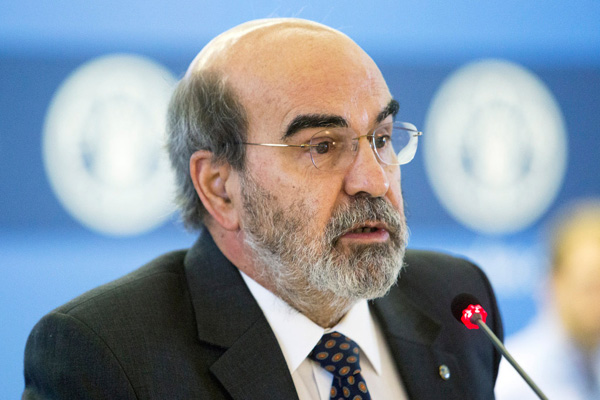
FAO Director-General José Graziano da Silva addresses the opening session of the Committee on World Food Security (CFS) 41st Session in Rome. Photo: FAO/©Giulio Napolitano
Support Our Journalism
We cannot do without you.. your contribution supports unbiased journalism
IBNS is not driven by any ism- not wokeism, not racism, not skewed secularism, not hyper right-wing or left liberal ideals, nor by any hardline religious beliefs or hyper nationalism. We want to serve you good old objective news, as they are. We do not judge or preach. We let people decide for themselves. We only try to present factual and well-sourced news.
Support objective journalism for a small contribution.


