


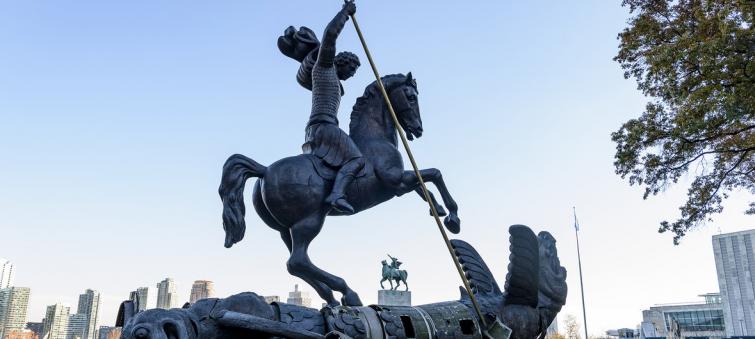
UN chief laments ending of Cold War-era disarmament treaty
New York, Aug 3 (IBNS): Secretary-General António Guterres expressed his “deep regret” on Friday that the landmark Intermediate-Range Nuclear Forces (INF) Treaty betweein the United States and Russia came to an end.
In a statement issued by his spokesperson, the UN chief recalled that he had “consistently called on both the United States and the Russian Federation to resolve their differences through the consultation mechanisms provided for in the Treaty and regrets they have been unable to do so”.
In 1987, US and Soviet Union leaders Ronald Reagan and Mikhail Gorbachev signed the INF treaty to eliminate land-based nuclear missiles and medium-range arsenals from Europe.
Guterres noted that “in the current deteriorating international security environment, previously-agreed arms control and disarmament agreements are increasingly under threat”.
Since its entry-into-force on 1 June 1988, the Cold War-era arms control contributed tangibly to the maintenance of peace and stability internationally and especially in Europe, playing an important role in reducing risk, building confidence and helping to bring the Cold War to an end.
According to news reports, both sides walked away from the pact, each blaming the other for its demise and triggering fears of a new arms race.
“The Secretary-General emphasizes the need to avoid destabilizing developments and to urgently seek agreement on a new common path for international arms control”, the statement said.
Guterres calls on Russia and the US “to extend New START and to undertake negotiations on further arms control measures”, concluded the statement.
UN Photo/Manuel Elias
Support Our Journalism
We cannot do without you.. your contribution supports unbiased journalism
IBNS is not driven by any ism- not wokeism, not racism, not skewed secularism, not hyper right-wing or left liberal ideals, nor by any hardline religious beliefs or hyper nationalism. We want to serve you good old objective news, as they are. We do not judge or preach. We let people decide for themselves. We only try to present factual and well-sourced news.
Support objective journalism for a small contribution.


