


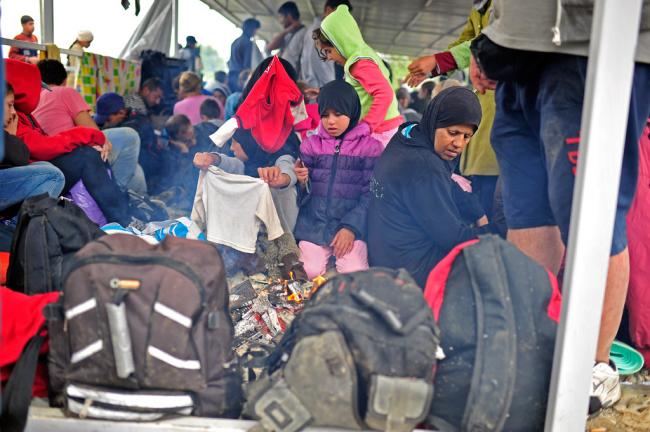
UN opens support 'hubs' to boost protection for families and children on move across Europe
Some 20 Child and Family Support Hubs, called 'Blue Dots', will provide a safe space for children and their families, as well as vital services, play, protection and counselling in a single location, the UN refugee agency (UNHCR) and the UN Children's Fund (UNICEF) said in joint press release today.
The hubs aim to support vulnerable families on the move, especially the many unaccompanied or separated children at risk of sickness, trauma, violence, exploitation and trafficking.
“We are concerned about the welfare of unaccompanied boys and girls on the move and unprotected across Europe, many of whom have experienced war and hardship in making these journeys alone,” said UNHCR Assistant High Commissioner for Protection Volker Türk.
“The hubs will play a key role in identifying these children and providing the protection they need in an unfamiliar environment, where they may be at risk,” he added.
The first hubs are now operational or about to open in Croatia, the former Yugoslav Republic of Macedonia, Greece, Serbia and Slovenia. All 20 will be operational within the next three months, the agencies said.
The hubs come at a time when women and children account for two thirds of those crossing to Europe. In February, women and children made up nearly 60 per cent of sea arrivals, compared with 27 per cent in September 2015, according to the agencies. The centres will also aim to identify and protect children and adolescents travelling alone, and reunite them with family wherever possible.
“The lives of children on the move have been turned upside down, they have faced turmoil and distress every step of the way. The hubs will offer a level of predictability, certainty and safety in their uncertain lives, a place where they can get the help and support that is every child's right. And they will contribute to stronger national child protection systems,” said Marie-Pierre Poirier, UNICEF's Special Co-ordinator for the Refugee and Migrant Crisis in Europe.
The agencies underscored that identifying children in need is challenging. In some countries, young travellers pretend to be adults to avoid being delayed or detained on their journey, exposing them to the risk of exploitation. This past year, more than 90,000 unaccompanied or separated children registered and applied for asylum or were in care in Europe, mostly in Germany and Sweden.
The hubs will be located in select strategic sites – border entry/exit points, registration sites and some strategic urban centres – as well as through mobile/outreach teaThe services include restoring family links – services provided by the Red Cross and Red Crescent network; family reunification; child-friendly spaces and dedicated mother and baby/toddler spaces; private rooms for counselling; psycho-social first aid; legal counselling; safe spaces for women and children to sleep; outreach social workers; and an information desk with Wi-Fi connectivity.
Photo: UNICEF/Tomislav Georgiev
Support Our Journalism
We cannot do without you.. your contribution supports unbiased journalism
IBNS is not driven by any ism- not wokeism, not racism, not skewed secularism, not hyper right-wing or left liberal ideals, nor by any hardline religious beliefs or hyper nationalism. We want to serve you good old objective news, as they are. We do not judge or preach. We let people decide for themselves. We only try to present factual and well-sourced news.
Support objective journalism for a small contribution.


