


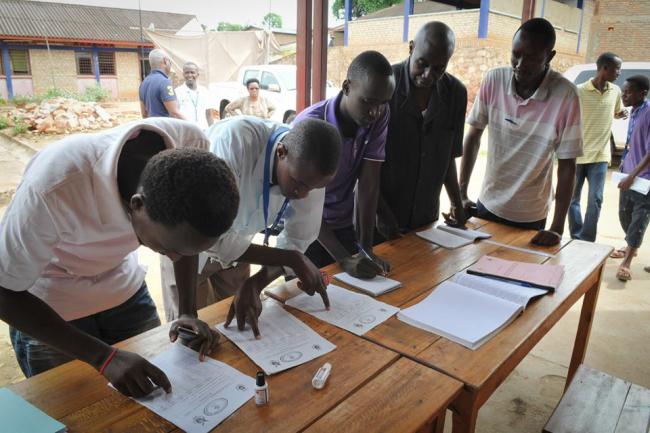
UN political chief says Burundi making strides towards 'peaceful, credible' elections
“Burundi has made substantial progress, overcoming the formidable challenges since the end of the civil war,” Under-Secretary-General for Political Affairs, Jeffrey Feltman, said in a briefing to the Security Council earlier today.
“As in previous elections, the 2015 elections present Burundians with the opportunity to further strengthen peace consolidation efforts undertaken since the Arusha Accord.” However, cautioned Feltman, the creation of a ‘peaceful and credible’ electoral process would hinge on the impartiality and independence of the country’s Independent National Electoral Commission (CENI), the free exercise of civil and political rights for all Burundians, the Government’s prevention of violence without infringing on civil liberties and the immediate prosecution of all violent acts “without delay.”
Despite outbursts of violence in certain areas of the country which risk heightening current political tensions, Burundi’s multifaceted challenges also extend to a wider slate of issues relating to health, education, employment, and infrastructure, all of which need to be “at the heart of the debate,” he told the Council.
“Addressing the remaining challenges will require the efforts of all Burundians and sustained support from Burundi’s development partners,” he concluded. “I am pleased to note that the United Nations will continue to provide support through the Peacebuilding Fund to enhance political dialogue and social cohesion; youth participation in political and socio-economic life; human rights; and resolution of land disputes.”
The Security Council set the creation of the UN Electoral Observation Mission (MENUB) in motion last February following the Burundi Government’s request for a UN-backed electoral observer mission before, during and after Burundi’s upcoming 2015 elections. MENUB officially began its work two weeks ago with a ceremony in Bujumbura.
It replaced the UN Office in Burundi (BNUB), which was set up in 2006 following a ceasefire between the Government and the last remaining rebel forces to support peace consolidation, democratic governance, disarmament and reform of the security sector. BNUB wrapped up its mandate at the end of last year.
Meanwhile, in his remarks to the Council, Ambassador Paul Seger of Switzerland, Chair of the Burundi configuration of the UN Peacebuilding Commission (PBC), said he had been ‘heartened’ by the discussions he had with national stakeholders during his most recent trip to Burundi from 9 to 12 December. Nonetheless, he added, issues related to the country’s current security and political situation, the UN’s presence on the ground, and the future of the PBC, continued to warrant the UN body’s attention.
In particular, Seger told the Council he remained concerned about the spate of recent violence which had rippled across the Burundian provinces of Cibitoke and Ruyigi, fomenting mistrust between the Government and opposition and resulting in a ‘significant number of victims,’ which he deplored.
According to reports, on 30 December, the Burundian army reported clashing with an unidentified armed group of approximately 100 to 200 members entering Cibitoke from neighbouring Democratic Republic of the Congo. Following fighting between the two sides, some 100 members of the armed group were killed. Meanwhile, in a separate incident in Ruyigi, five unidentified gunmen dressed in military fatigues executed three members of the ruling party in a bar 250 kilometres east of Bujumbura, the country’s capital.
“I strongly recommend the competent national authorities to pursue investigations into the events in a quick and impartial manner,” he stated, warning that “as long as facts are not established, rumours will spread and further fuel an already tense political environment in the run up to the elections.”
As a result, he called on all Burundian stakeholders to continue along the “path of dialogue.”
“This cannot be stressed enough,” he continued. “Only a truly inclusive political dialogue and open political space that ensures the protection of all public liberties and rights for all can lay a fertile ground for genuinely free, fair, peaceful and credible elections.”
Against that backdrop, Seger noted that the UN presence on the ground was “undergoing substantial changes” amid BNUB’s drawdown, the UN Development Programme’s (UNDP) appointment of a Resident Coordinator to the country, and the ‘dire’ financial situation affecting the UN human rights office’s (OHCHR) Burundi operations which had already provoked the loss of experienced staff.
To that point, he urged Member States to contribute the necessary financial resources to the OHCHR, totalling $2.2 million per year, underlining that human rights support and monitoring ‘remain as important as ever in Burundi.’
Finally, turning to the future of the PBC itself, he suggested there was ‘merit’ in the body’s continued engagement in Burundi beyond the elections as it would add both “an element of continuity in the accompaniment of the country” and provide a future focus on socio-economic development.
“BNUB is already gone and MENUB’s mandate is also bound to expire in the aftermath of the elections,” Seger explained. “The PBC can help smooth the effects of this transition by remaining engaged through its three main pillars: political accompaniment, resource mobilization and forging coherence in international assistance.”
Photo: MENUB
Support Our Journalism
We cannot do without you.. your contribution supports unbiased journalism
IBNS is not driven by any ism- not wokeism, not racism, not skewed secularism, not hyper right-wing or left liberal ideals, nor by any hardline religious beliefs or hyper nationalism. We want to serve you good old objective news, as they are. We do not judge or preach. We let people decide for themselves. We only try to present factual and well-sourced news.
Support objective journalism for a small contribution.


