


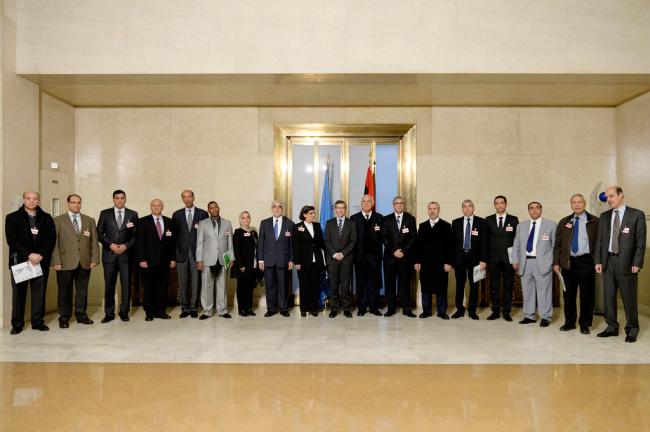
UN urges Libya’s stakeholders to pursue next round of talks
This follows recent political and security developments, particularly last week’s deadly terrorist bombings in the City of Al-Qubbah and the decision of the House of Representatives in Libya to suspend its participation in the political dialogue. The latest wave of violence has further rattled the war-weary nation, in conflict since the beginning of its civil war in 2011, which resulted in the ouster of late Libyan leader Muammar Gaddafi.
In a statement, the Mission said it “would like to clarify a number of misconceptions in recent media coverage regarding the talks” the latest round of which took place in Geneva last month.
The UN-facilitated Libyan dialogue was conducted in a “responsible and serious environment, with a high sense of resolve and determination” with the hopes of reaching a comprehensive political agreement to end the country’s crisis and restore security, the Mission said.
“The participants and the United Nations were fully transparent during their work on the dialogue; decisions were made by participants after broad and inclusive deliberations and consultations,” it emphasized, adding that ending the “severe political division” in Libya is of critical importance, since its continuation will pose a clear threat to the unity of the country.
It said, “Accordingly, it is urgent and necessary to reach an agreement on a strong and independent Government, whose highest priority should be restoring the confidence of the citizens in the Libyan State, as well as provision of services and combatting terrorism, since terrorism has become a real threat to the political process, the Libyan State, and the security and stability of the country and the region.”
The UN-backed dialogue is intended to produce proposals to be endorsed by Libyan stakeholders and supported by the people. All decisions made by participants, whether related to the consensus government’s mechanism, method of formulation, or to security arrangements related to the ceasefire, are first and foremost Libyan decisions that are made by the consensus of the participants, the Mission said.
In that regard, Special Representative of the Secretary-General Bernardino León, who also heads up UNSMIL, has reiterated to Libyan leaders the neutrality of the UN on many occasions, the last of which when he contacted Interim Prime Minister Abdullah Al-Thinni to offer condolences for the victims of the terrorist bombings in Al-Qubbah.
In that telephone conversation, León reiterated that a political agreement is the safeguard to Libya’s unity and ability to combat terrorism, and asked for the interim government’s public support for the dialogue. The Special Representative also assured Al-Thinni that the international community remains fully supportive of the dialogue.
Libya’s protracted conflict has caused a serious humanitarian crisis, with at least 120,000 people forced to flee their homes, resulting in consequent shortages in both food and medical supplies along with mounting numbers of casualties.
Photo: UN Photo/Jean-Marc Ferré (file)
Support Our Journalism
We cannot do without you.. your contribution supports unbiased journalism
IBNS is not driven by any ism- not wokeism, not racism, not skewed secularism, not hyper right-wing or left liberal ideals, nor by any hardline religious beliefs or hyper nationalism. We want to serve you good old objective news, as they are. We do not judge or preach. We let people decide for themselves. We only try to present factual and well-sourced news.
Support objective journalism for a small contribution.


