


World must do more to help support Syrian refugees in Lebanon: UN
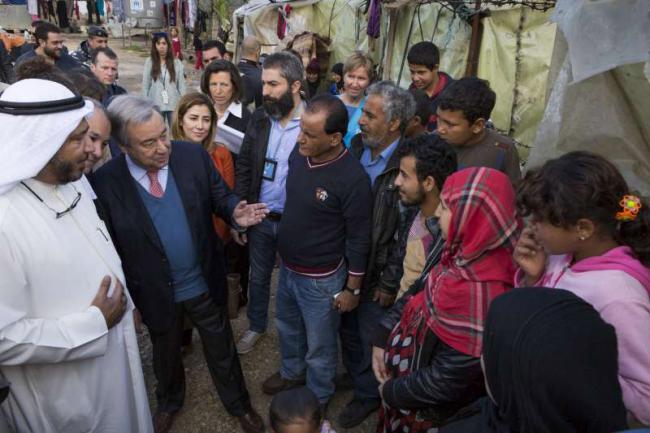
The UN High Commissioner for Refugees (UNHCR), António Guterres, made his comments, while in Debane, close to the southern city of Ghaziye, where he was visiting some of the 1.2 million Syrians who have sought refuge in Lebanon because of fighting in their country.
“The equivalent of what we have in Lebanon in the United States would be [equivalent to] more than 80 million refugees coming into the United States,” said Guterres, drawing attention to the fact that Syrian refugees currently make up of Lebanon’s total population.
He added, “You can understand that this has a terrible impact on the economy and society of Lebanon.”
Syrian refugees have settled in all parts of Lebanon, putting a huge strain on already-stretched services and infrastructure.
Almost a fifth of Syrian refugees in Lebanon live in informal settlements like Debane, a huddle of 23 makeshift shelters built from wooden planks and plastic sheeting and currently home to 30 Syrian families.
Located on a strip of public land, the refugees are not allowed to make permanent constructions, with the result that living and sanitary conditions remain basic.
The High Commissioner was joined by Abdullah Al-Matouq, the UN Secretary-General’s Humanitarian Envoy for Kuwait. The pair met residents of the settlement and discussed their concerns and the challenges they face, including Government regulations on residency, and lack of access to education.
Of the 400,000 school-age Syrian children in Lebanon, UNHCR and the UN Children’s Fund (UNICEF) are only able to provide funding for 106,000 places in the country’s State schools with the remaining three quarters receiving no formal education.
Guterres said the visit had highlighted the dramatic needs not only of the Syrian refugees, but also the Lebanese Government and communities hosting them, together with other host countries in the region.
He welcomed pledges totalling $3.8 billion for the Syria crisis response in 2015 made by international donors at a conference in Kuwait last month, but stressed that even more would be needed due to the scale of the catastrophe.
“We cannot accept that the Syrian people will go on living in these absolutely tragic circumstances, and we cannot accept that countries like Lebanon and Jordan are facing such a dramatic challenge to their own economies and to their own stability,” he said.
Photo: UNHCR/I. Prickett
Support Our Journalism
We cannot do without you.. your contribution supports unbiased journalism
IBNS is not driven by any ism- not wokeism, not racism, not skewed secularism, not hyper right-wing or left liberal ideals, nor by any hardline religious beliefs or hyper nationalism. We want to serve you good old objective news, as they are. We do not judge or preach. We let people decide for themselves. We only try to present factual and well-sourced news.
Support objective journalism for a small contribution.


