


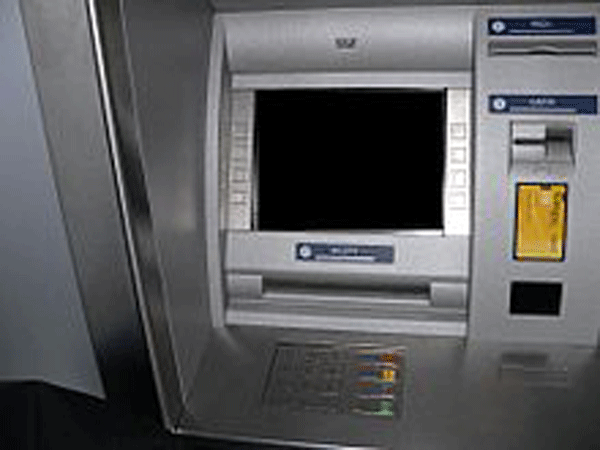
ATM keypads in New York City hold microbes from human skin, says study
The work shows that ATMs can provide a repository to offer a picture of a city’s DNA.
“Our results suggest that ATM keypads integrate microbes from different sources, including the human microbiome, foods, and potentially novel environmental organisms adapted to air or surfaces,” explains senior study author Jane Carlton, director of the Center for Genomics and Systems Biology and professor of biology at NYU. “DNA obtained from ATM keypads may therefore provide a record of both human behavior and environmental sources of microbes.”
During the study—published this week in mSphere, an open access journal from the American Society for Microbiology—the scientists in June and July 2014 took swabs of keypads from 66 ATM machines in eight neighborhoods over three New York boroughs: Manhattan, Queens, and Brooklyn, read the university website.
The research team’s sequencing methods revealed an array of human skin microbes.
Specifically, the most common identified sources of microbes on the keypads were household surfaces such as televisions, restrooms, kitchens and pillows. Researchers also found microbes from bony fish, mollusks, and chicken in different New York City neighborhoods, suggesting that residual DNA from a meal may remain on a person’s hands and be transferred to the ATM keypad upon use while also pointing to a link between geography and specific microbes.
ATM keypads located in laundromats and stores had the highest number of biomarkers with the most prominent being Lactobacillales (lactic acid bacteria), which is usually found in decomposing plants or milk products. In samples from Manhattan, researchers observed the biomarker Xeromyces bisporus, which is associated with spoiled baked goods.
Researchers found no significant difference in the keypads from ATMs located outdoors versus indoors.
Since each ATM keypad in New York City is most likely utilized by hundreds of people each day (and may come into contact with air, water, and microbes from different urban surfaces), the microbial communities obtained in this study may represent an “average” community that is effectively pooled from vastly different sources, notes study co-author Maria Gloria Dominguez-Bello, an associate professor in NYU School of Medicine’s Human Microbiome Program.
Overall, the samples had low diversity and showed no obvious clustering by geography. The relative lack of diversity among locations could result from periodic cleaning of the machines, which would wipe out some of the microbes, as well as usage of ATMs by tourists, commuters from other locations, the researchers said.
The work was partially funded by a New York University Grand Challenge project called “Microbes, Sewage, Health and Disease: Mapping the New York City Metagenome.”
The paper’s first author was Holly Bik, a postdoctoral researcher in NYU’s Center for Genomics and Systems Biology at the time of the study and now an assistant professor at the University of California at Riverside.
The study’s other authors included: Julia Maritz, a doctoral candidate in NYU’s Department of Biology; Albert Luong, a student at NYU School of Medicine; and Hakdong Shin, a postdoctoral fellow at NYU School of Medicine.
The research, linked to a larger effort to study microbes across New York City, was supported, in part, by the Sloan Foundation.
Image: Wikimedia Commons
Support Our Journalism
We cannot do without you.. your contribution supports unbiased journalism
IBNS is not driven by any ism- not wokeism, not racism, not skewed secularism, not hyper right-wing or left liberal ideals, nor by any hardline religious beliefs or hyper nationalism. We want to serve you good old objective news, as they are. We do not judge or preach. We let people decide for themselves. We only try to present factual and well-sourced news.
Support objective journalism for a small contribution.


