


 UK Heatwave
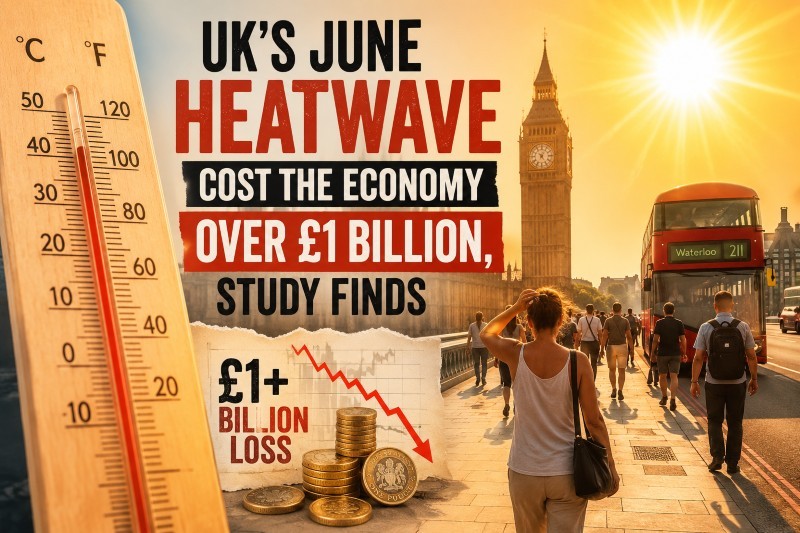
Britain's scorching June heatwave wiped out more than £1 billion in just weeks
The heatwave in June 2026 led to 24 million lost hours of working and a £1.15 billion hit to the UK economy, according to new research published today (23 July 2026) by the Grantham Research Institute on Climate Change and the Environment at the London School of Economics and Political Science and the Euro-Mediterranean Center on Climate Change (CMCC).
For the study, the researchers surveyed a nationally representative sample of 1,950 adults across the UK about how they perceived impacts of the heatwave on working hours, ability to sleep and any changes to how they travelled to work or their working environment. The survey related to the week beginning 22 June 2026.
Elizabeth Robinson and Shouro Dasgupta were able to estimate the economic cost, in terms of lost output caused by the heatwave, derived from workers’ responses about adjustments they made to their working hours. The impact of £1 billion-plus in lost output is on top of the negative impacts on workers’ health and increased pressure on health services.
They found that the “average reported reduction in hours worked across the week was 0.47 hours”. Those working in jobs more highly exposed to heat and that are physically demanding, in sectors such as construction and agriculture, reduced their hours by more than those working in low-exposure and physically undemanding jobs such as academia.
Findings from the survey show 3.6% of respondents, equivalent to approximately 1.25 million workers in the population, did not work at all that week because of the heat. This is equivalent to an additional 8 million lost hours, at an estimated cost to the economy of £0.38 billion.
87% of workers reported at least one health-related impact during the week of 22 June 2026, ranging from disrupted sleep and being more tired at work through to a small number of workers reporting more extreme symptoms including dizziness or fainting and a faster heartbeat.
The survey also found that 5% of respondents sought medical attention and around 3% reported an accident or injury at work during that week, and around two-thirds of them felt it was linked to the weather. Women, those aged under 35 and people with existing health conditions were the groups most likely to report that their health was harmed.
Elizabeth Robinson, Director of the Grantham Research Institute on Climate Change and the Environment, said: “Our findings point to a country that remains insufficiently adapted to the changing climate.
“The Government cannot continue to ignore extreme heat. Unless it acts now, and makes workplaces safer, we are likely to see growing impacts on workers’ productivity, health, and the economy.”
Shouro Dasgupta, Environmental Economist at CMCC and Visiting Senior Fellow at the Grantham Research Institute , said:
“While £1 billion is lost overall, the greatest effects are borne by outdoor workers and those in physically demanding jobs, many of whom are among the lowest paid in the labour force.
“Extreme heat is widening existing inequalities in the labour force.”
Support Our Journalism
We cannot do without you.. your contribution supports unbiased journalism
IBNS is not driven by any ism- not wokeism, not racism, not skewed secularism, not hyper right-wing or left liberal ideals, nor by any hardline religious beliefs or hyper nationalism. We want to serve you good old objective news, as they are. We do not judge or preach. We let people decide for themselves. We only try to present factual and well-sourced news.
Support objective journalism for a small contribution.


