


Haiti cholera outbreak ‘stopped in its tracks’
New York/IBNS: After a nine-year long cholera outbreak in Haiti that killed close to 10,000 people, this week the country reached the milestone of an entire year free from any new cases of the deadly waterborne disease.
This was achieved following concerted efforts from the Pan American Health Organization (PAHO), the Haitian Government and others, to address the root causes of cholera.
“Cholera is a disease of inequity that unduly sickens and kills the poorest and most vulnerable people – those without access to clean water and sanitation,” said PAHO Director, Dr. Carissa F. Etienne.
The last confirmed case was a boy under age five in I’Estère in the Artibonite department of Haiti during the last week of January 2019.
He was admitted to hospital on the 24 of January last year and recovered shortly thereafter.
Motorbike strategy key
Rapid detection and testing are key to controlling outbreaks.
PAHO and the Haitian Ministry of Health’s Labo Moto project, which enables field nurses to move rapidly around the field by motorcycle, carrying samples from treatment centers to laboratories, has increased testing rates from 21 per cent in 2017, to 95 per cent two years later.
“Death from cholera is preventable with tools that we have today but to ensure that cholera remains a distant memory, we must also accelerate investments in clean water and adequate sanitation in Haiti”, stated Dr. Etienne.
Labo Moto is part of a three-step strategy to ensure that all suspected cases from high-risk areas are tested; random patient sampling with diarrhoea is taken in all areas of the country; and event-based surveillance is carried out by epidemiologists.
Cholera elimination
Despite progress, Haiti remains behind the rest of Latin America and the Caribbean in terms of access to potable water and sanitation, according to PAHO.
Far below the regional average, some 35 per cent of Haitians lack basic drinking water services and two-thirds have limited or no sanitation services.
“While cholera is under control for now, we must collectively remain alert and ready to maintain this status and verify elimination”, stressed Dr. Etienne.
To end cholera in Haiti, with validation from the World Health Organization (WHO) for eliminating the disease, the country must maintain effective surveillance systems and remain cholera-free for two more years, which would equal three years in total.
Early detection and response to any possible flare-ups must continue and clean water and sanitation for all Haitian people is key to preventing the transmission of cholera, and other water-borne diseases, in the long-term.
“Only when we ensure all Haitians enjoy access to clean water and sanitation can we breathe more freely”, concluded the PAHO chief.
Last week, the UN marked the tenth anniversary of Haiti’s devastating earthquake, and the UN chief Antonio Guterres said during his speech at a ceremony in New York, that the UN deeply regretted “the loss of life and suffering caused” by the epidemic, which began in 2010, and is widely believed to have been imported by UN peacekeepers.
Embed:
WHO
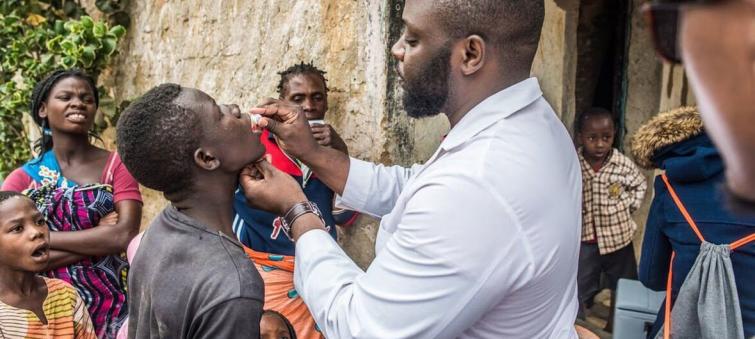
A child is administered an oral vaccine against cholera as part of a large-scale vaccination campaign.
Support Our Journalism
We cannot do without you.. your contribution supports unbiased journalism
IBNS is not driven by any ism- not wokeism, not racism, not skewed secularism, not hyper right-wing or left liberal ideals, nor by any hardline religious beliefs or hyper nationalism. We want to serve you good old objective news, as they are. We do not judge or preach. We let people decide for themselves. We only try to present factual and well-sourced news.
Support objective journalism for a small contribution.


