


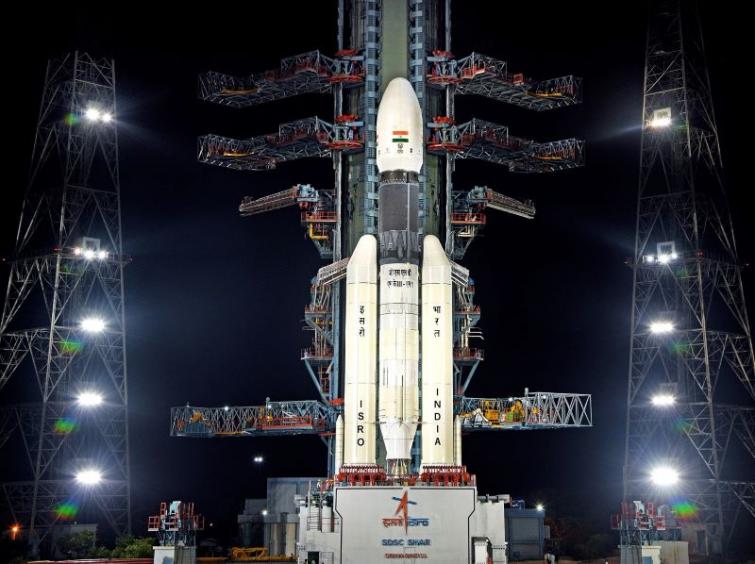
India waits with bated breath for Chandrayaan 2 launch at 2-43 pm
Bengaluru, July 22 (IBNS): While the countdown continued for the launch of Chandrayaan 2, which will head out for the moon, the big moment will come at 2-43 pm on Monday (today). The moon mission of India assumes significance since it will explore a region in the moon that has been shown to contain water ice.
"The launch countdown of #GSLVMkIII-M1/#Chandrayaan2 commenced today at 1843 Hrs IST. The launch is scheduled at 1443 Hrs IST on July 22nd," tweeted Indian's space research organisation ISRO a day ago.
🇮🇳 #ISROMissions 🇮🇳
— ISRO (@isro) July 21, 2019
The launch countdown of #GSLVMkIII-M1/#Chandrayaan2 commenced today at 1843 Hrs IST. The launch is scheduled at 1443 Hrs IST on July 22nd.
More updates to follow... pic.twitter.com/WVghixIca6
Chandrayaan-2 will carry an Orbiter, Lander (Vikram) and Rover (Pragyan), take to skies on Monday from the SHAR Range at Sriharikota, commencing its 3.844 lakh km, month-long journey for a soft landing on the Moon's South Pole.
Weighing 3,850 kg, the launch of Chandrayaan-2, would take place from the Second Launch Pad at 1443 on Monday afternoon when the 43.43m tall heaviest homegrown rocket, Geosynchronous Satellite Launch Vehicle Mark-III (GSLV MkIII-M1), capable of launching 4-ton class of satellites to the Geosynchronous Transfer Orbit (GTO), lifts off from the spaceport.
ISRO sources said the Launch rehearsal has been completed and much to their delight the performance was normal.
After a meeting of the Launch Authorisation Board and Mission.Readiness Review Committee, the countdown for the launch would begin.
The launch was earlier scheduled on July 15, but was deferred an hour before the take-off due to a technical snag in the launch vehicle.
"A technical snag was observed in launch vehicle system at one hour before the launch. As a measure of abundant precaution Chandrayaan-2 launch has been called off for today," it was announced by ISRO then.
A technical snag was observed in launch vehicle system at 1 hour before the launch. As a measure of abundant precaution, #Chandrayaan2 launch has been called off for today. Revised launch date will be announced later.
— ISRO (@isro) July 14, 2019
On July 18, ISRO announced that the expert committee identified the root cause of the technical snag and all corrective actions were implemented.
''Thereafter, the system performance is normal and Chandrayaan-2 launch is now rescheduled for July 22 at 1443 hrs," it said.
According to American website CNET, all three of ISRO's robotic explorers have different lifespans and will be looking to achieve key science goals in their limited time exploring the moon.
"Chief among these goals is the ability to understand the composition of the moon, allowing for a deeper understanding of its origin and its evolution. There are 12 payloads on board, with five on both the orbiter and lander and two on the rover. The lander will only operate for a single lunar day (two weeks on Earth). NASA is also hitching a ride on the lunar lander with a laser retroreflector, a device that can help measure the distance between the Earth and Moon," it reported.
The orbiter will operate for a year in a circular orbit around the poles and carries radar and spectrometers that will enable study of the moon's surface and exosphere, it reported.
"Predominantly, these instruments should enable a greater understanding of the moon's water ice deposits. A mapping camera will also provide a 3D map of the terrain," it said.
Support Our Journalism
We cannot do without you.. your contribution supports unbiased journalism
IBNS is not driven by any ism- not wokeism, not racism, not skewed secularism, not hyper right-wing or left liberal ideals, nor by any hardline religious beliefs or hyper nationalism. We want to serve you good old objective news, as they are. We do not judge or preach. We let people decide for themselves. We only try to present factual and well-sourced news.
Support objective journalism for a small contribution.


