


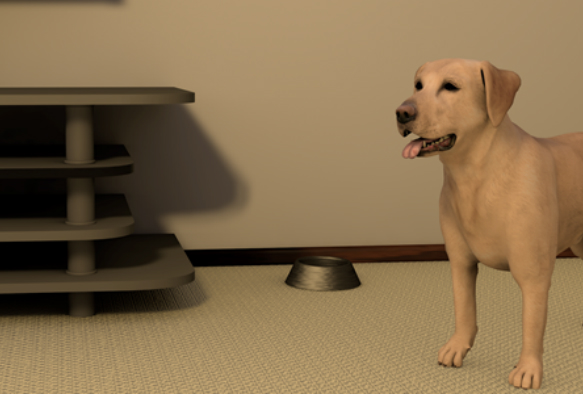
Meet the virtual pooch that could help prevent dog bites: Study
London, Aug 25 (IBNS): A virtual dog could soon be used as an educational tool to help prevent dog bites, thanks to an innovative project led by the University’s Virtual Engineering Centre (VEC).
In collaboration with Dogs Trust and University of Liverpool animal behaviour researchers, the VEC has created a proof of concept virtual reality (VR) experience in which people can approach and interact with a dog displaying signs of aggression in a safe and controlled way.
The experience aims to help adults and children recognise specific behaviours displayed by dogs, which could potentially lead to an attack or incident if not correctly identified.
6,740 hospital admissions for dog bites and strikes were recorded in the UK in 2013 and University of Liverpool research suggests that the burden of dog bites is considerably larger than those estimated from hospital records.
As part of a desire to better educate children and adults about dog bite prevention, Dogs Trust wanted to explore whether a digital tool could help people identify a range of stress and threat behaviours typically exhibited by dogs, which have the potential to lead to a bite.
In response to this challenge, a team of animal behavioural specialists and psychologists from the University worked closely with the VEC to make certain that the body language and detail shown in the virtual environment was both realistic and a truthful reflection of real world canine behaviour.
As the user approaches the dog, the behaviour and body language of the dog gradually changes, the dog’s behaviour begins to display signs of aggression including licking its lips, lowering of the head and body, front paw lifting, growling, and showing of teeth. These behaviours are referenced from the ‘Canine Ladder of Aggression’ which shows how a dog may behave when it does not want to be approached.
Iain Cant, VEC Visualisation Team Leader said: “This was a really interesting project to work on with a lot of exciting potential for the future.
“The next steps will look to enhance the detail within the immersive environment to ensure the simulation is as realistic as possible. Future developments will also show a wider range of dog behaviours and the dog’s reactions to user behaviour.”
“More broadly the project highlights how immersive experiences can be used by organisations such as Dogs Trust as a valuable educational tool.”
Image: University of Liverpool website
Support Our Journalism
We cannot do without you.. your contribution supports unbiased journalism
IBNS is not driven by any ism- not wokeism, not racism, not skewed secularism, not hyper right-wing or left liberal ideals, nor by any hardline religious beliefs or hyper nationalism. We want to serve you good old objective news, as they are. We do not judge or preach. We let people decide for themselves. We only try to present factual and well-sourced news.
Support objective journalism for a small contribution.


