


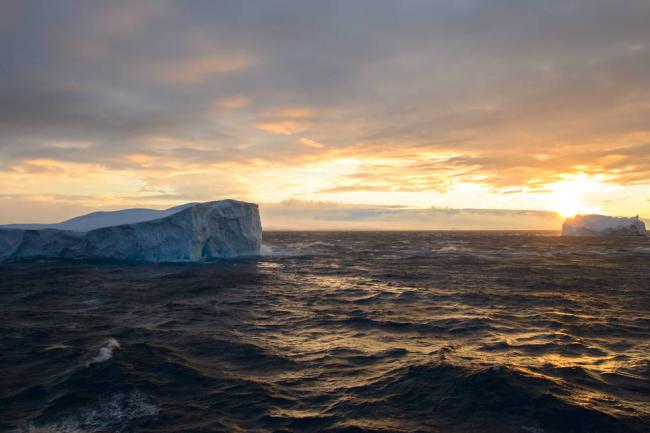
NASA takes part in Airborne Study of Southern Ocean
Called ORCAS, the field campaign will provide a rare look at how oxygen and carbon dioxide are exchanged between the air and the Southern Ocean. The campaign is led by the National Center for Atmospheric Research (NCAR), read the NASA website.
Michelle Gierach of NASA's Jet Propulsion Laboratory, Pasadena, California, is a principal investigator, along with other scientists from a range of universities and research institutions.
Carbon dioxide is the main greenhouse gas contributing to human-caused climate change. As more carbon dioxide has been released into the atmosphere by the burning of fossil fuels, the ocean has stepped up the amount of the gas it absorbs from the air. But it's unclear whether the ocean can keep pace with continued emissions.
Previous studies have disagreed about whether the Southern Ocean's ability to absorb carbon dioxide is speeding up or slowing down. The measurements and air samples collected by ORCAS -- which stands for the O2/N2 Ratio and CO2 Airborne Southern Ocean Study -- will give scientists critical data to help clarify what's happening in the remote region.
The researchers plan to make 14 flights out of Punta Arenas, Chile, across parts of the Southern Ocean during the campaign, which ends Feb. 28. A suite of instruments will measure the distribution of oxygen and carbon dioxide, as well as other gases produced by marine microorganisms, microscopic airborne particles and clouds. The flights also will observe ocean color -- which can indicate how much and what type of phytoplankton is in the water -- using NASA's Portable Remote Imaging Spectrometer (PRISM). The scientists hope that adding these other measurements to the carbon dioxide data will give them new insight on chemical, physical and biological processes that are affecting the ocean's ability to absorb the greenhouse gas.
"The Southern Ocean is very inaccessible, and existing measurements represent only a few tiny dots on a huge map," said NCAR's Britton Stephens, co-lead principal investigator for ORCAS. "Understanding the Southern Ocean's role is important, because ocean circulation there provides a major opportunity for the exchange of carbon between the atmosphere and the vast reservoir of the deep ocean."
Image credits: Flickr user Reeve Jolliffe/CC BY-NC-ND 2.0
Support Our Journalism
We cannot do without you.. your contribution supports unbiased journalism
IBNS is not driven by any ism- not wokeism, not racism, not skewed secularism, not hyper right-wing or left liberal ideals, nor by any hardline religious beliefs or hyper nationalism. We want to serve you good old objective news, as they are. We do not judge or preach. We let people decide for themselves. We only try to present factual and well-sourced news.
Support objective journalism for a small contribution.


