


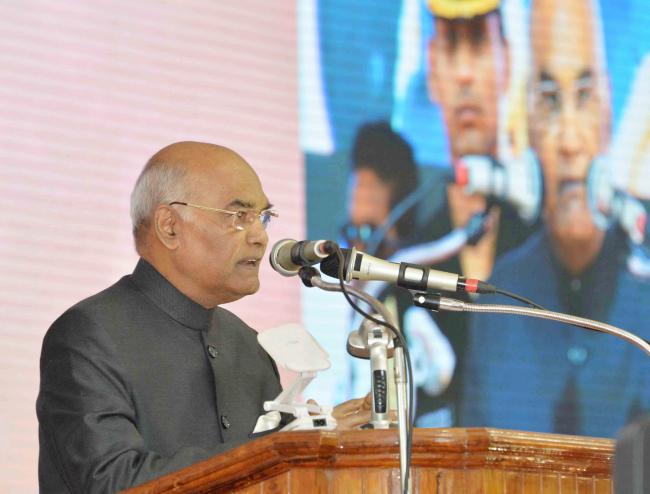
Prez inaugurates 4th India International Science Festival; urges scientific community to partner university researchers
New Delhi, Oct 6 (IBNS): President Ram Nath Kovind on Saturday inaugurated the 4th India International Science Festival in Lucknow.
Speaking on the occasion, the President said that science has always been a part of Indian culture.
"Centuries ago, our ancestors were uncovering the secrets of mathematics and the concept of the zero. They were applying the lessons of science in fields as far apart as medicine and metallurgy. From the Green Revolution to our space programme to the creation of a thriving biotech and pharmaceutical industry, science has driven our post -1947 modernisation. Today, in the first quarter of the 21st century, in the age of robotics and precision manufacture, of bioinformatics and gene editing, of the Fourth Industrial Revolution and Artificial Intelligence, it is time for a quantum jump," he said.
Kovind said, "We cannot make that jump without converting science into a mass movement – and without promoting tinkering and innovation as an everyday activity in our labs, our universities and even our schools. Jugaad, cut-paste experiments and frugal innovation have their role. Even so, if we are to transform India into a middle-income economy and an advanced industrial power, we need to upgrade the engines of knowledge creation."
"Science and technology are not a mere add-on – their cross-cutting nature and role in every field and in all our flagship programmes and developmental efforts have to be appreciated," said he.
The President said that the role of science and scientific innovation in our national developmental agenda is expanding day by day. In 2017, patent applications by Indian start-ups rose to 909.
"This was a 15-fold increase from the number in 2016 – just 61. In 2018, India’s R&D investments will amount to an appreciable US$ 83.27 billion. The government has announced the Prime Minister’s Research Fellowship Scheme. It will promote development through innovation and has a budget of Rs 1,650 crore for seven years beginning 2018-19. These are exciting times for science in India. The resources are now available. It is for our talent pool to respond," said he.
The President said that science is done best when it is a collaborative venture, with resources – including funding resources – and facilities being shared. This is the era of partnerships between research centres and universities.
He urged the scientific community to mentor and to open its doors to budding researchers and students in universities.
Kovind said that budding researchers and students look to senior scientists for guidance, support and access to laboratories and equipment.
" With such generosity of spirit and of intellect, Indian science will carry much greater weight. And it will move closer to building a best-in-class ecosystem," said he.
The President pointed to the low participation of women in higher science.
He noted that of the 3,446 scientists working at the Council of Scientific and Industrial Research, only 632 – or 18.3 per cent – are women.
Kovind said that in a week when women scientists have won Nobel Prizes for physics and for chemistry, this is a telling statistic.
"It is a reminder of the scientific potential of our daughters that we are not adequately harnessing. This is both a social and systemic challenge – but it is our collective responsibility to overcome it," added he.
Support Our Journalism
We cannot do without you.. your contribution supports unbiased journalism
IBNS is not driven by any ism- not wokeism, not racism, not skewed secularism, not hyper right-wing or left liberal ideals, nor by any hardline religious beliefs or hyper nationalism. We want to serve you good old objective news, as they are. We do not judge or preach. We let people decide for themselves. We only try to present factual and well-sourced news.
Support objective journalism for a small contribution.


