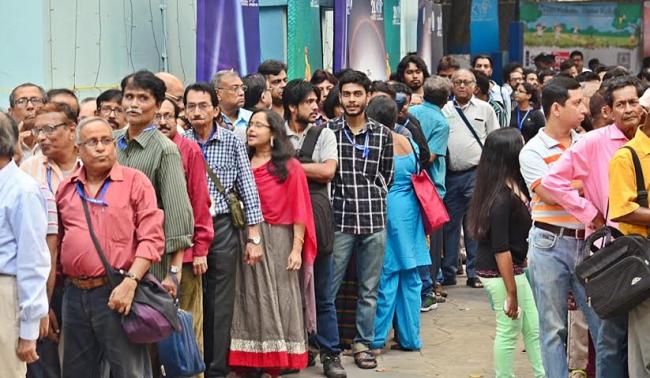
21st KIFF Remembering Orson Welles’ Citizen Kane (1941)
“Rosebud” is the most important uttered sound in Citizen Kane, the dying Kane's last word, the secret to his sorrow. It is the name of his childhood sled, ultimately thrown into the flames as oblivion sears through the film’s final scenes.[i] What seems a fairy-tale simplification, a motif from the props department, opens up to become part of the film's resonance. More literally, it is the bud that opens for the audience by being the bud that does not open in the film. On screen “Rosebud” tells us that Kane's life was nipped in its growth by a too-early rendezvous with wealth and destiny. But in the film, “Rosebud” communicates the opposite. The spell of the word grows and grows. Like so much in the film, it starts as a hint, and expands by a process of change, association, counterpoint and contradiction into the holistic and all-comprehending.[ii]
Charles Foster Kane in Citizen Kane dies saying the word ‘Rosebud’. The film narrated in flashback with this scene sends reporters flurrying to find out what he meant by that word. But there is an irony here. The irony lies in that the reporters keep searching for what they think the word means while Kane is the only person who knew what it meant and he is no more. We see what it means when the camera closes in on a shot of the sled with the word ‘Rosebud’ still visible.
The sled resembles Kane’s innocence as a child. It has no use-value for him once he goes away. But he carries faint resonances of the sled within his sub-conscious that surfaces in his dying moments. The reporter searches for some deeper meaning when it just means a boy’s toy and nothing more. But does the sled really suggest ‘nothing more’? Interestingly, the sled is ‘absent’ through the film except in the beginning and the end. The first time we see the sled is in Kane’s flashback. The last time we see it at the end of the film being eaten up by the flames of the fire it has been cast into.
About his use of the sled Rosebud in the film as an object, a metaphor and a symbol, Welles said: “I wished the camera to show beautiful things, ugly things and useless things, too—indeed everything, which could stand for a public career and a private life. I wished objects of art, objects of sentiment, and just plain objects. There was no way for me to do this except to make my character, as I have said, a collector, and to give him a great house in which to keep his collections. The house itself occurred to me as a literal translation in terms of drama of the expression “ivory tower.” The protagonist of my “failure story” must retreat from a democracy which his money fails to buy and his power fails to control. —There are two retreats possible: death and the womb. The house was the womb. Here too was all the grandeur, all the despotism, which my man had found lacking in the outside world. Such was his estate—such was the obvious repository for a collection large enough to include, without straining the credulity of the audience—a little toy from the dead past of a great man.”
(Reported by Shoma A. Chatterji)
[i] Andrews, Nigel: The Mark of Kane – Orson Welles Masterpiece, 70 Years On, Financial Times, May 8 2011.
[ii] Ibid.
Support Our Journalism
We cannot do without you.. your contribution supports unbiased journalism
IBNS is not driven by any ism- not wokeism, not racism, not skewed secularism, not hyper right-wing or left liberal ideals, nor by any hardline religious beliefs or hyper nationalism. We want to serve you good old objective news, as they are. We do not judge or preach. We let people decide for themselves. We only try to present factual and well-sourced news.
Support objective journalism for a small contribution.