 Bilingual Book of Poems
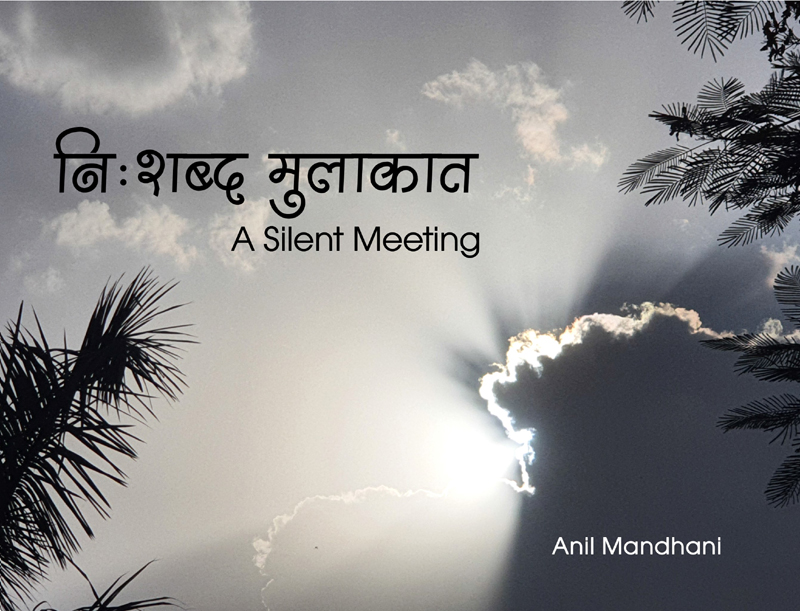
Author interview: Anil Mandhani on his bilingual book of poems ‘Nishabd Mulakat: A Silent Meeting’
Anil Mandhani talks about the emotions that every medical doctor goes through in the course of their profession and how he channelises those emotions into poetry
Congratulations on the release of "Nishabd Mulakaat". You are not a full-time writer, but a doctor by profession. How and when do you manage time to write in between your regular busy career?
I am neither a seasoned author nor have literary charisma but I must say that there is no profession other than the medical one, when you are close to the objective reality of all the emotions. In our day-to-day interaction while treating ailing patients, we see the most of the emotive responses, like love, hate, indifference, pain, sorrow, gratitude, affection, selflessness etc. These responses are unpretentious and one needs to have an eye to see those responses and feel for it. Fortunately I have an eye for that and I capture them and convert them into words. That is it!
Tell us something about your book. It has beautiful photos and also poems / quotations. What is the idea behind this?
One of my favorite times of the day is when I go outside for a walk mostly to green patches or water bodies. While walking, I talk to various so-called inanimate creatures, like trees, earth, air and the whole environment, which reciprocate to my attention and then I capture those dialogues in a picture frame.
Your book also shows the photographer in you. When do you usually nurture that hobby and what are your favorite subjects?
I have no technical knowledge of photography and I just carry a phone to capture these moments.
What kind of books inspire you as a writer? Who are your favorite authors and poets?
As I believe in objective reality, so most of the books I read are non-fiction, biographies or memoir. I love reading books on philosophy too.
Recently I read, all three books by Yuval Noah Harari i.e. Homo Deus, Sapiens and 21 lessons for 21st century, Mind without Fear by Rajat Gupta, biographies of contemporary giants like Elon Musk, Sundar Pichai, Steve Jobs and The Story of My Experiments with Truth by M K Gandhi. Other favorite authors are Victor Frankle, Richard Dawkins, Albert Camus, George Orwell and Robert Pirsig to name a few.
Who or what inspired you to nurture the creative side in you? The photographer and writer / poet in you - who or what triggered you to become a writer and photographer?
As doctors, we are deeply attached to emotions of human kind. Every time we see patients, whom as strangers, we meet for the first time but we end up developing an emotional bond. Many times, it generates a narrative or a moment worth remembering. Similar kind of bonding, I develop with nature, which too evokes similar emotive responses, which is captured either in a frame or in words. This book is just a result of that.
Do you plan to come up with more books in future? What will the topics be like?
I have written poems on what I have seen in my practice of medicine in the last 30 years. That would be my second book to share with the readers.
Tell us something about yourself and your professional background.
I grew up in a small town called Raipur, now it is the capital city of Chhattisgarh. I have seen every facet of hardship and was unfortunate to have missed good schooling. My mother was not educated but she was literate and only aim in her life was to see me become a doctor.
Despite constraints, I had a one-track mind and that was to become a doctor, as my father was a doctor too. Unfortunately, I lost him when I was just five years old. I had a glimpse of him, which left an indelible impression on my mind to follow suit. My elder brother too is a doctor who brought me up.
My medical schooling took place in Raipur and after finishing my surgical training in 1993, I moved to Delhi to pursue higher education. I wanted to be a cardiothoracic surgeon but after working in Escorts, Delhi for seven days, I changed my mind and decided to become a Urologist. I took my training in Urology in SGPGIMS, Lucknow and took a voluntary retirement after working there for 21 years. Currently I am chairing the Department of Urology and Kidney Transplant in Fortis Memorial Research Institute, Gurugram in Delhi NCR region, India.
Support Our Journalism
We cannot do without you.. your contribution supports unbiased journalism
IBNS is not driven by any ism- not wokeism, not racism, not skewed secularism, not hyper right-wing or left liberal ideals, nor by any hardline religious beliefs or hyper nationalism. We want to serve you good old objective news, as they are. We do not judge or preach. We let people decide for themselves. We only try to present factual and well-sourced news.
Support objective journalism for a small contribution.