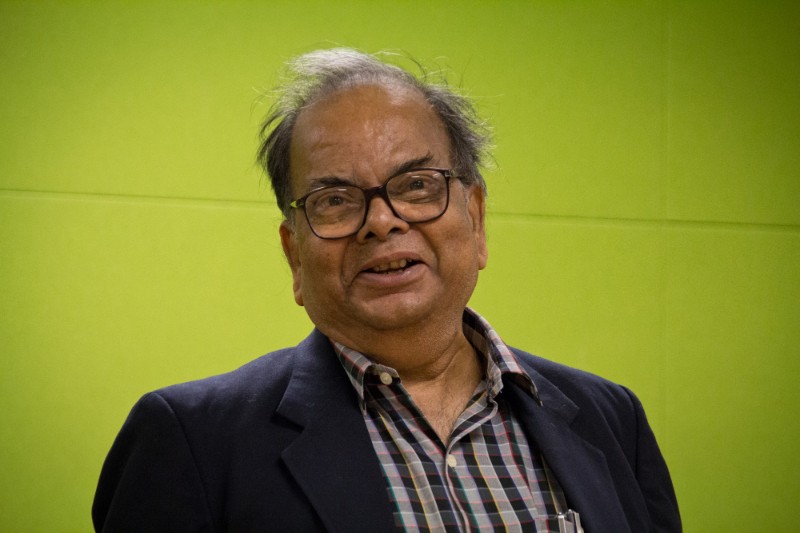
 Shankar
'Chowringhee' author is no more! Veteran Bengali novelist 'Shankar' dies at 93
Kolkata/IBNS: Eminent Bengali novelist Mani Shankar Mukhopadhyay, popularly known by his pen name Shankar, died in a Kolkata hospital on Friday afternoon, family members confirmed.
He was 93 and had been suffering from prolonged ill health.
One of the most widely read and influential writers in modern Bengali literature, Shankar is survived by his two daughters.
A towering figure in Bengali literature
Shankar earned enduring acclaim for novels that captured the emotional, moral and social complexities of urban life, particularly in post-Independence Kolkata.
His works resonated across generations for their sharp observation, empathy for flawed characters and unflinching engagement with ambition, loneliness and compromise.
West Bengal Chief Minister Mamata Banerjee expressed her condolences, describing him as a towering literary figure whose writings would continue to inspire readers for decades to come.
‘Chowringhee’ and the anatomy of a city
Among Shankar’s vast body of work, Chowringhee remains his most iconic novel.
Set within the fictional Shahjahan Hotel on Kolkata’s Chowringhee Road, the book transformed a luxury hotel into a mirror of a newly independent nation grappling with class divides, desire and moral uncertainty.
Narrated through the eyes of a young receptionist, the novel introduced readers to a gallery of unforgettable characters, including fading aristocrats, ambitious professionals and emotionally adrift guests.
Beneath the hotel’s polished surfaces lay vulnerability and quiet despair, rendered with Shankar’s trademark irony and compassion.
The novel’s cultural impact extended beyond literature when it was adapted into a popular 1968 Bengali film directed by Pinaki Mukherjee, cementing its place in Bengali popular culture.
‘Jana Aranya’ and the cost of survival
If Chowringhee captured the glamour and melancholy of urban aspiration, Jana Aranya exposed the darker underbelly of middle-class life.
Often translated as The Middleman or The Human Jungle, the novel traces the moral descent of Somnath, an educated but unemployed young man drawn into unethical business practices simply to survive.
Written with stark realism, the book reflected the economic stagnation and unemployment crisis of 1970s Kolkata.
Its relevance deepened when it was adapted into a landmark 1976 film by Satyajit Ray, forming the final part of Ray’s celebrated Calcutta Trilogy.
Shankar and Goenkas
Shankar’s literary understanding of power and ambition was shaped by his own professional life.
Early in his career, he worked as a stenographer and later as a senior executive under industrialist Badridas Goenka, a prominent figure of the Goenka business family.
His exposure to boardrooms, corporate hierarchies and ethical dilemmas profoundly influenced his fiction.
This experience found its most direct expression in Seemabaddha, a novel that dissected corporate ambition and moral compromise in post-Independence India.
The book was later adapted by Satyajit Ray as part of the Calcutta Trilogy, further enhancing its critical stature.
A prolific and enduring legacy
Over a long and prolific career, Shankar wrote numerous novels and short stories that explored domestic life, romance, social change and psychological conflict.
His works included Kato Ajanare, drawn from his early life experiences, Gharer Madhye Ghar, later translated as Thackeray Mansion, as well as Samrat O Sundari, Subarno Sujog and Manob Sagar Tire, among many others.
Beyond fiction, he also authored the acclaimed biography The Monk as Man: The Unknown Life of Swami Vivekananda, offering a deeply human portrait of the revered spiritual leader.
Support Our Journalism
We cannot do without you.. your contribution supports unbiased journalism
IBNS is not driven by any ism- not wokeism, not racism, not skewed secularism, not hyper right-wing or left liberal ideals, nor by any hardline religious beliefs or hyper nationalism. We want to serve you good old objective news, as they are. We do not judge or preach. We let people decide for themselves. We only try to present factual and well-sourced news.
Support objective journalism for a small contribution.