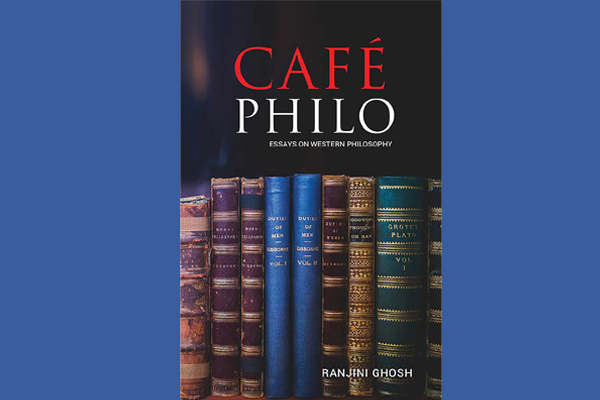
Cafe Philo: A layman's guide to western philosophy
This book has been written by Ranjini Ghosh and it is definitely one-of-a-kind.
No doubt it is very uncommon to find books on serious topics like these and yet this book is a fun read in its own way.
Each of the twenty-three chapters deals with one particular concept.
For example, the first chapter talks about certainty and truth. Descartes was the revered man who worked on this concept and his ideologies and perspectives have been discussed here.
The second chapter talks about the concept of equality while the third is about ethics.
Each of the topics is interesting and relevant in our daily lives and it is indeed fascinating to read what the famous philosophers had to say about these basic concepts of human life.
All the discussions have been done on a level where it is possible for a layman to understand what all the complicated laws might mean.
Philosophy as a whole is not an easy subject to understand but here the discussions are quite easy to follow.
All the essays in this book have been written after a lot of research, that much is pretty evident, and the author has done a good job of bringing forth really important and interesting topics for the general readers most of whom would have no clue about these concepts.
One discussion that struck me the most is from the second chapter.
In a discussion of the principle of equal consideration of interests drafted by Peter Singer, it was asked what would be right thing to do if there are two injured men—one who is in greater pain and who is in relatively lesser pain—and we have only two shots of morphine?
The theorem urged us to give both the shots to the man in greater pain so that both the injured men suffer from the same intensity of pain. This would be the right way of ensuring equality in this situation. Well, I found this perspective really fascinating.
Nobel laureate Amartya Sen has said that progress happens not when there is equal distribution of resources but when there is equal distribution of capabilities.
He says that it is not enough to give everyone equal numbers of pens and books and notebooks but what matters is that everyone should be able to use the stationery with equal efficiency.
Books like 'Cafe Philo' have a special place in the market today because with evolving choices, people are becoming more inquisitive.
A person from a science background may want to know about philosophical theories.
In India, our education system is not flexible enough and it doesn’t give students the chance to explore subjects from different branches.
But having books like these can fill in the gap and enable a hardcore science student to understand philosophical theorems easily.
This book is definitely capable of gaining popularity and adulation with time.
Reviewed By Priya Das
Support Our Journalism
We cannot do without you.. your contribution supports unbiased journalism
IBNS is not driven by any ism- not wokeism, not racism, not skewed secularism, not hyper right-wing or left liberal ideals, nor by any hardline religious beliefs or hyper nationalism. We want to serve you good old objective news, as they are. We do not judge or preach. We let people decide for themselves. We only try to present factual and well-sourced news.
Support objective journalism for a small contribution.