 László Krasznahorkai
László Krasznahorkai: Meet the Hungarian author who won the 2025 Nobel Prize in Literature
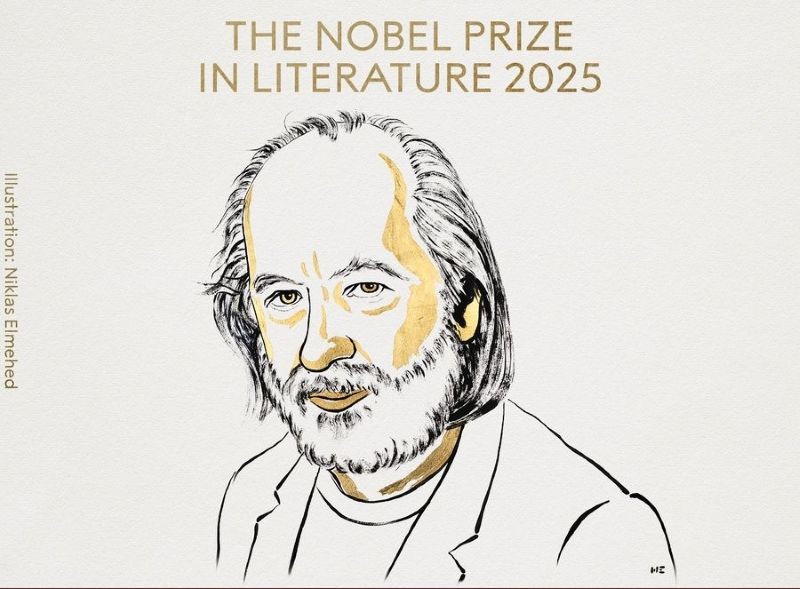
Hungarian writer László Krasznahorkai has been awarded the 2025 Nobel Prize in Literature for “his compelling and visionary oeuvre that, in the midst of apocalyptic terror, reaffirms the power of art,” the Swedish Academy announced on Thursday.
“I am very happy,” the 70-year-old author told Swedish broadcaster Sveriges Radio, as quoted by the BBC. “I’m calm and very nervous altogether,” he said after learning of the honour.
Born in 1954 in Gyula, a small town in southeastern Hungary near the Romanian border, Krasznahorkai gained international acclaim with his debut novel Sátántangó (1985; translated as Satantango, 2012). The work, set in a desolate collective farm in the Hungarian countryside on the brink of communism’s collapse, became a literary sensation in Hungary and marked his breakthrough.
Often described as a great epic writer in the Central European tradition of Kafka and Thomas Bernhard, Krasznahorkai’s prose is known for its long, meandering sentences, absurdist tone, and darkly comic exploration of human despair.
BREAKING NEWS
— The Nobel Prize (@NobelPrize) October 9, 2025
The 2025 #NobelPrize in Literature is awarded to the Hungarian author László Krasznahorkai “for his compelling and visionary oeuvre that, in the midst of apocalyptic terror, reaffirms the power of art.” pic.twitter.com/vVaW1zkWPS
His 2003 novel Északról hegy, Délről tó, Nyugatról utak, Keletről folyó (A Mountain to the North, a Lake to the South, Paths to the West, a River to the East, English translation 2022) unfolds as a lyrical and meditative tale set southeast of Kyoto, Japan.
Krasznahorkai, whose works have been translated into several languages, previously received the Man Booker International Prize in 2015.
Support Our Journalism
We cannot do without you.. your contribution supports unbiased journalism
IBNS is not driven by any ism- not wokeism, not racism, not skewed secularism, not hyper right-wing or left liberal ideals, nor by any hardline religious beliefs or hyper nationalism. We want to serve you good old objective news, as they are. We do not judge or preach. We let people decide for themselves. We only try to present factual and well-sourced news.
Support objective journalism for a small contribution.