 Supreme Court
'Do ED officers lose rights when on duty?' Supreme Court grills Mamata govt over I-PAC raid row
New Delhi/IBNS: The Supreme Court of India has raised pointed questions to the West Bengal government during a hearing on alleged interference in Enforcement Directorate (ED) operations linked to a political consultancy firm.
In a sharp observation, the bench asked whether officers of the Enforcement Directorate lose their fundamental rights simply because they are on official duty.
Court focuses on rights of individual officers
The bench, comprising Justices PK Mishra and NV Anjaria, emphasised that the matter was not limited to an institutional dispute.
It pointed out that several ED officers had approached the court in their personal capacity, claiming they were victims of obstruction during the investigation.
Justice Mishra underlined that the focus should remain on whether the officers’ fundamental rights were violated.
He cautioned against reducing the issue to a purely procedural or institutional argument.
I-PAC raids at centre of dispute
The case stems from searches conducted in early January at the offices of the Indian Political Action Committee, commonly known as I-PAC, which has worked with the ruling Trinamool Congress in West Bengal.
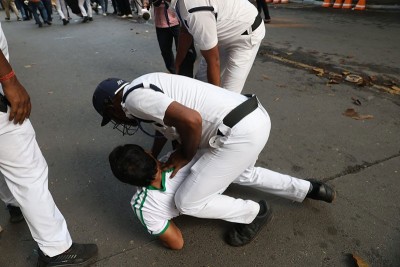
The ED has alleged that Chief Minister Mamata Banerjee and state officials interfered with its operations during a money laundering investigation.
Debate over Article 32 petition
Senior advocate Kapil Sibal, representing the state government, argued that the ED’s petition under Article 32 of the Constitution was not maintainable.
He contended that the agency had alternative legal remedies, such as approaching the police, in case of obstruction.
Sibal further maintained that the right to investigate a case stems from statutory powers rather than fundamental rights.
According to him, any disruption of such duties does not automatically amount to a violation of constitutional rights.
The court, however, signalled that this argument may not fully address the grievances raised by individual officers who claimed personal harm.
Court rejects hearing delay plea
The bench also dismissed suggestions to defer the hearing due to the upcoming West Bengal Assembly elections.
It made clear that judicial proceedings would not be influenced by electoral timelines.
The judges asserted that the court is neither aligned with political processes nor willing to delay adjudication on that basis, reinforcing the principle of judicial independence.
Legal and political stakes remain high
The case highlights a complex intersection of law enforcement authority, constitutional rights and political tensions between state and central institutions.
As proceedings continue, the court’s observations are expected to shape the legal debate around the rights of investigative officers and the limits of state intervention during central agency operations.
Support Our Journalism
We cannot do without you.. your contribution supports unbiased journalism
IBNS is not driven by any ism- not wokeism, not racism, not skewed secularism, not hyper right-wing or left liberal ideals, nor by any hardline religious beliefs or hyper nationalism. We want to serve you good old objective news, as they are. We do not judge or preach. We let people decide for themselves. We only try to present factual and well-sourced news.
Support objective journalism for a small contribution.