 Piyush Goyal
India achieves 4,000 pct solar capacity growth: Piyush Goyal
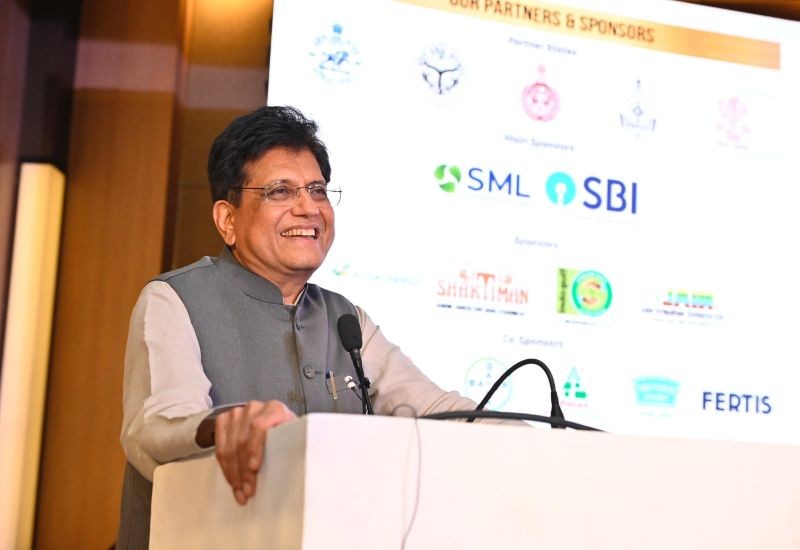
Union Minister of Commerce and Industry, Piyush Goyal, while addressing the 11th India Energy Storage Week (IESW) 2025 in New Delhi, noted the 4,000% increase in India’s installed solar capacity and stated that the country’s renewable energy capacity now stands at a robust 227 GW.
He said India is likely the first G20 nation to have met its Nationally Determined Contributions (NDCs) under the Paris Agreement.
Goyal cited the example of Palli village in Jammu and Kashmir, which has become India’s first carbon-neutral panchayat using solar energy and energy efficiency.
He pointed out that the IESW venue, Yashobhoomi, is itself a model of sustainability, featuring rooftop solar installations, wastewater treatment, and energy-efficient infrastructure.
Highlighting India's manufacturing progress in the last decade, Goyal said that the country’s solar photovoltaic module capacity has increased nearly 38-fold, while photovoltaic cell capacity has risen 21-fold.
He mentioned the PM Surya Ghar Yojana, which aims to equip 1 crore households with rooftop solar panels to make them energy self-sufficient and reduce electricity bills.
He also spoke of the PM Kusum Yojana, which supports the expansion of solar pumps in India’s agrarian economy. Additionally, the government has launched a Production Linked Incentive (PLI) programme to boost manufacturing of Advanced Chemistry Cells (ACC), he added.
Congratulating India Energy Alliance and partners for curating IESW, Goyal appreciated their efforts in bringing together clean energy, storage technologies, green hydrogen, and e-mobility solutions under one platform.
He emphasised that India is on a focused path to becoming energy sufficient, with the aim of having renewable energy sources power the country’s growing needs round the clock.
The Minister underscored the importance of storage technologies—whether in the form of batteries, pumped storage, hydro storage, or geothermal—as essential for meeting India’s future energy demands.
He highlighted that the energy sector will be a driving force in India's transition to clean and renewable sources of power, and this vision has already been reflected in the country’s achievements over the last decade.
The Minister emphasised that various forms of energy storage, such as pump storage and battery systems, as well as nuclear power, will support the clean energy transition. He also underlined the critical role that stakeholders will play in this mission.
Proposing a comprehensive four-pronged approach for advancing India’s energy independence, Union Minister Piyush Goyal emphasised the need for targeted innovation, infrastructure development, supply chain resilience, and holistic value chain growth.
He stated that India must lead in research and development for energy storage by focusing on next-generation battery chemistries, solid-state and hybrid storage technologies, and circular supply chains.
Highlighting the recent Cabinet approval of a ₹1 lakh crore Research, Development and Innovation Fund under the leadership of Prime Minister Narendra Modi, he noted its potential to match R&D investments of ₹6–7 lakh crore in advanced economies, given India’s cost advantages.
On infrastructure, the Minister called for enhanced collaboration among stakeholders to build both charging and battery swapping systems, thereby accelerating electric vehicle adoption and ensuring affordable, accessible e-mobility.
He also urged the industry to build supply chain resilience by reducing dependence on specific geographies and adopting new technologies to achieve self-reliance in the energy sector.
Finally, Goyal stressed that India’s ambition should encompass the entire value chain—from raw materials and cell components to battery packs, semiconductors, management systems, and recycling—ensuring a robust and self-sustained clean energy ecosystem.
The Minister urged stakeholders to explore new opportunities to scale up operations and strengthen competitiveness
Support Our Journalism
We cannot do without you.. your contribution supports unbiased journalism
IBNS is not driven by any ism- not wokeism, not racism, not skewed secularism, not hyper right-wing or left liberal ideals, nor by any hardline religious beliefs or hyper nationalism. We want to serve you good old objective news, as they are. We do not judge or preach. We let people decide for themselves. We only try to present factual and well-sourced news.
Support objective journalism for a small contribution.