 UN agencies
India deepens regional statistical ties in cooperation with UN agencies
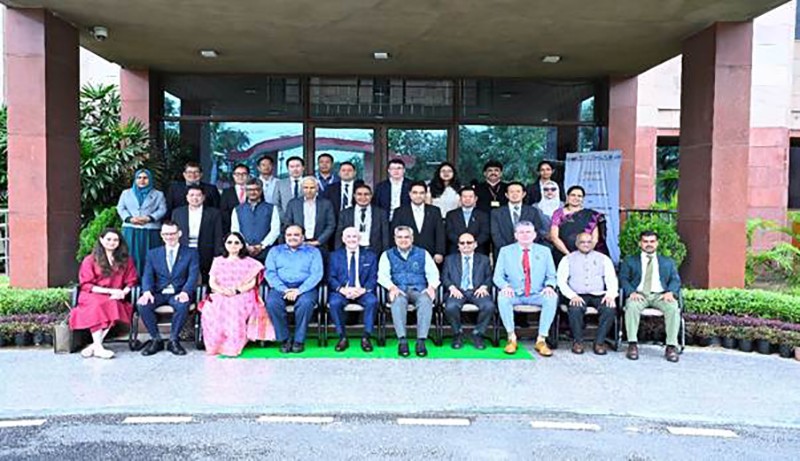
Indian Ministry of Statistics and Programme Implementation (MoSPI), as an active member of the United Nations Statistical Commission (UNSC), is hosting three days’Regional Workshop, in cooperation with the United Nations Statistical Institute for Asia and the Pacific (UN SIAP) and the United Nations Statistics Division (UNSD) on “Data Ethics, Governance, and Quality in a Changing Data Ecosystem” for 16 countries in the Asia-Pacific region.
The workshop was held from July 14 to July 16.
The workshop reflects India’s commitment to collaborative, ethical, and future-ready data ecosystems.
This workshop brings together Chief Statisticians/Heads of National Statistical Offices (NSO’s) and other Senior Statisticians from 16 countries namely Bhutan, Cambodia, Fiji, Georgia, India, Indonesia, Kazakhstan, Laos, Malaysia, Maldives, Mongolia, Nepal, Sri Lanka, Thailand, Timor-Leste, and Viet Nam.
The workshop is honoured to host eminent Chief Statisticians and Heads of National Statistical Offices (NSO’s) – Sonam Tenzin (Bhutan), Gogita Todradze (Georgia), Aishath Hassan (Maldives), Batdavaa Batmunkh (Mongolia), Sonny Harry Budiutomo (Indonesia), and Elias dos Santos (Timor-Leste) - whose experiences and insights will enrich the regional discourse.
Their participation underscores the shared regional commitment to innovation and integrity in official statistics.
National Statistical Systems Training Academy (NSSTA), Central Training Institute under Ministry of Statistics and Programme Implementation (MoSPI), Government of India, is first time organising this kind of workshop and it reflects India’s long-standing tradition of excellence in official statistics and its regional and global leadership in advancing statistical capacity and governance. Through, NSSTA, MOSPI, India continues to play a pivotal role in capacity building of NSOs and promoting collective progress toward data-driven and inclusive development.
The workshop comprises four thematic sessions, focusing on: Evolving role of NSOs; Modernization of institutional and organizational frameworks to maintain relevance and credibility; Quality assurance in official statistics; and Adoption of modern statistical production architectures.
These are complemented by interactive breakout sessions and group discussions, offering space for peer learning and the exchange of experiences and innovative approaches tailored to national contexts.
The workshop aims to strengthen the capacity of NSOs across the Asia-Pacific region to remain relevant and trusted amid rapidly changing data landscape and increased demands for official statistics.
Post COVID-19 pandemic, ongoing challenges, amid the proliferation of new data sources and emerging technologies, tools, and the growing demand for disaggregated, timely, and high-quality data have reinforced the central role of official statistics in framing public policy and achieving sustainable development goals.
The workshop highlights the importance of South-South cooperation, recognizing that countries can learn from each other in tackling the complexities of today’s data ecosystem.
Sharing of good practices and challenges is essential to help NSOs adapt, embrace new technologies and data sources, and ensure that official statistics continue to serve as a cornerstone of informed policymaking.
The workshop commenced with an inauguration session chaired by Dr. Saurabh Garg, Secretary, MOSPI, and graced by esteemed dignitaries including Shombi Sharp, UNRC, India; Dr. Shailja Sharma, Director, UN SIAP; Gabriel Gamez, UNSD, Matthias Reister, UNSD, P R Meshram, Director General (Data Governance), MOSPI, K B Surwade, Additional Director General (Capacity Development Division), MOSPI, J S Tomar, Deputy Director General (NSSTA), MOSPI and other officers from Government of India and UN agencies.
During the inaugural session, key dignitaries emphasized the evolving role of data in policymaking, governance, its challenges and way forward.
Most of the delegates emphasized that this workshop is very timely and important as NSOs are revisiting their legislations, investing for modernizations and learning from this workshop will be very useful.
Shombi Sharp, UNRC India, informed that India is first country, who developed subnational SDG indicator framework and appreciated the significant achievement of India in terms of SDGs.
He also highlighted that globally a significant percentage of SDG targets are off-tracked and urged for stronger cooperation within the regions.
He appreciated the efforts of India in organising the workshop and its leadership in data stewardship.
Support Our Journalism
We cannot do without you.. your contribution supports unbiased journalism
IBNS is not driven by any ism- not wokeism, not racism, not skewed secularism, not hyper right-wing or left liberal ideals, nor by any hardline religious beliefs or hyper nationalism. We want to serve you good old objective news, as they are. We do not judge or preach. We let people decide for themselves. We only try to present factual and well-sourced news.
Support objective journalism for a small contribution.